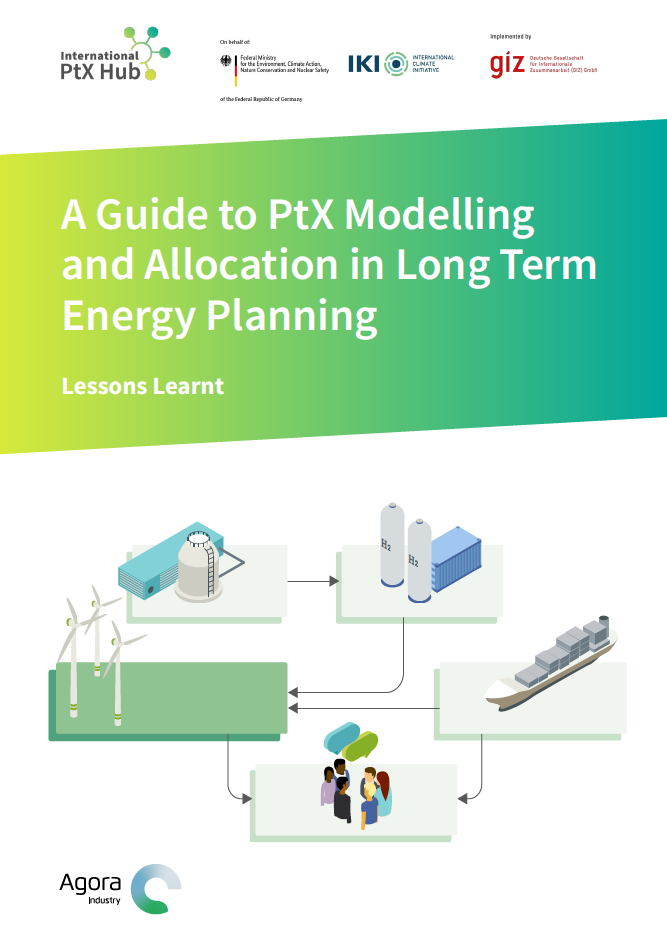
A Guide to PtX Modelling and Allocation in Long Term Energy Planning
Green hydrogen and Power-to-X will be key to the global energy transformation. Countries with favorable conditions for harnessing renewable energy are well placed to become global players in PtX production. However, as PtX is currently still expensive to develop, it should be allocated to applications such as aviation and shipping, which depend on it to become climate-neutral. For other applications, such as road transport, direct electrification through battery-electric systems is a more cost- and energy-efficient solution.
Countries must therefore develop their own specific approach to PtX, taking into account their different starting situations, individual motivations and various potentials for PtX production and application. This guide to a methodology for so-called “allocation studies” aims to identify national PtX pathways, meaning the cost-optimal distribution of PtX products among domestic applications – while also considering export potentials.
This is achieved through performing cost-optimisation modelling for a given country's energy system (long-term energy planning). It minimises the total energy system costs while staying within a given target year's greenhouse gas emissions cap. The optimisation then informs users about the cost-optimal applications for PtX – and, vice versa, of the applications for which PtX products should not be used from an economic perspective.
The proposed modelling covers different scenarios:
(1) business as usual
(2) the current NDC (Nationally Determined Contributions under the Paris Agreement) and long-term policy goals and
(3) carbon neutrality.
These scenarios are tailored to the context of each country in order to produce results that closely reflect national realities. A stakeholder consultation process is conducted in each country to inform the development of the scenarios, hence the scenario definitions vary across countries.
Building on the experience of previous PtX allocation studies conducted for Argentina and South Africa, this guide provides a framework for setting up and conducting PtX allocation studies. It highlights the lessons learnt, best practices and common pitfalls identified in past studies.
The reader will find a sample Terms of Reference for tendering PtX allocation studies in the annex.