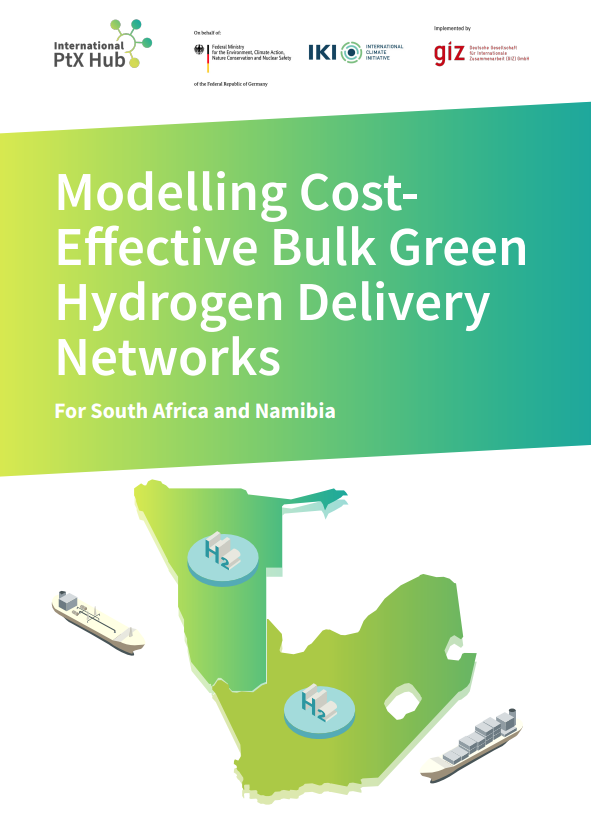
Modelling Cost-Effective Bulk Green Hydrogen Delivery Networks for South Africa and Namibia
This study provides an assessment of cost-effective delivery networks for Power-to-X (PtX) products across South Africa and Namibia.
As both countries aim to become competitive exporters on the PtX market, efficient and scalable delivery infrastructure - including pipelines, rail, road, and shipping - will be essential to meet their ambitions. Three infrastructure scenarios were analysed: one based on existing infrastructure, and two assuming unconstrained expansion, with and without the development of the Boegoebaai port.
To assess these scenarios, the study employs a spatial cost-optimisation model. It maps the flow of hydrogen from production to consumption nodes and identifies the most cost-effective delivery routes. The model also compares four PtX applications, considering their physical constraints: compressed gaseous hydrogen, liquefied hydrogen, green ammonia, and liquid organic hydrogen carriers. These pathways are examined across three timeframes: 2020, 2040 and 2050.
Key findings indicate that:
- The delivery of green ammonia via rail is a relevant option in South Africa and Namibia, provided that the demand for green ammonia is high enough.
- Coordination between South Africa and Namibia is crucial to strengthen PtX infrastructure in the Northern Cape ahead of the development of the Boegoebaai port.
- A deeper integrated PtX ecosystem can benefit both countries. Pipelines are not the only option; rail could also play a vital role as a north-south corridor.
- In South Africa’s interior, PtX production facilities could operate independently from the national network, if constraints about renewable energy supply are addressed.
Beyond the modelling results, the study offers a robust framework for future scenario testing and concludes with recommendations, highlighting the need to assess the infrastructure readiness for large-scale ammonia transport.