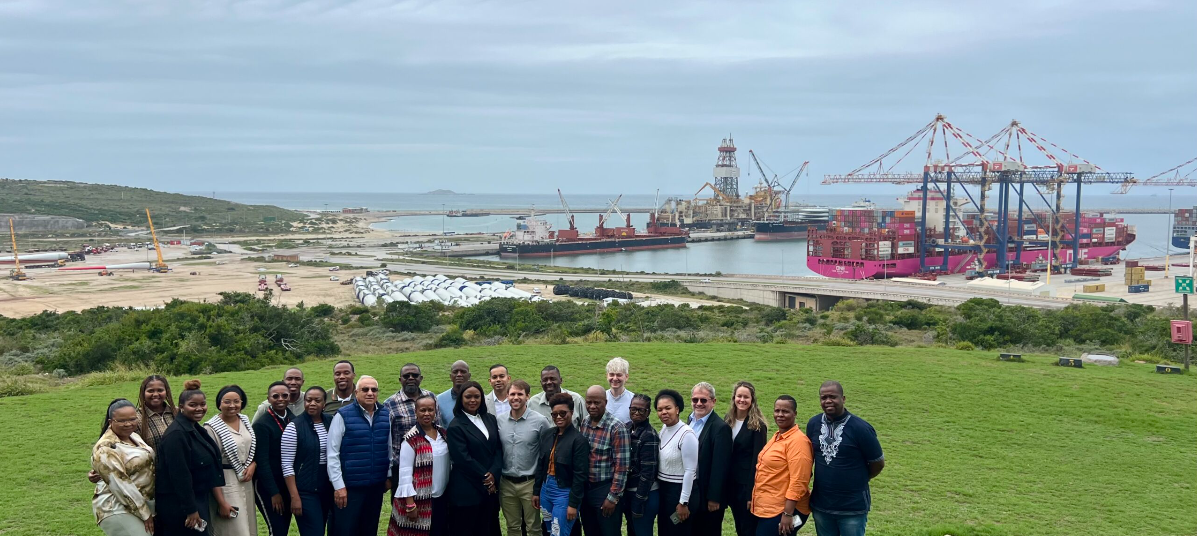
On a clear morning along South Africa’s Indian Ocean coast, the wind slips between rows of cranes at the Port of Ngqura, rattling the stacks of steel containers filled with manganese and wind turbine parts. The docks bustle, but the electricity driving most of that activity still comes from coal. A faint haze hangs above the water.
By 2050, that view must change. The port will need to run almost entirely on renewable power to protect the climate. The air will need to be cleaner. Ships will need new engines that run on renewable fuels. Ports must switch to renewable electricity wherever possible and handle and tank renewable fuels. Countries have agreed to phase out fossil fuels from shipping by around 2050, but the rules that will govern that shift are still being negotiated. Without those clear rules, investors are slow to commit.
The uncertainty stretches well beyond Ngqura. Governments across the world are wrestling with a similar question: green fuels exist, but they remain scarce and far more expensive than the diesel and heavy fuel oil they are meant to replace. That forces difficult choices. Who should get these fuels first? And which sectors deserve the public funding needed to make early projects viable?
To help answer those questions, the PtX Hub, a German international cooperation project, has been running detailed simulations in South Africa and Argentina. Its models point to a clear hierarchy. Sectors like aviation and shipping, which have few realistic alternatives to energy-dense green fuels, should receive priority access. Rail and road transports, by contrast, can use electricity directly. That approach, the researchers say, offers the most cost-efficient path to cutting emissions.
The simulations also spell out which infrastructure will need upgrading: which ports and export terminals will need to be adjusted or expanded to handle the new fuels and the ships that will rely on them. That matters in South Africa, where many green fuel business plans depend at least partly on exports to Europe or Japan. Ports are not just waypoints, but critical pieces of the transition.
In Ngqura, that change will take decades, but could be transformative. Terminals will need new electrical systems. Ships will need access to renewable power at berth. Equipment that still burns diesel or runs on coal-powered electricity will have to be replaced or retrofitted.
“But it’s not just about switching from coal to wind and solar,” said Johannes Arndt, Energy Advisor at the PtX Hub. “It’s about rethinking and redesigning the port, so it’s prepared for long-term change.” He added that a port positioned as a green energy hub, especially if one of the first to start the transition, could draw new investment and fix persistent inefficiencies through automation and digital systems.
Some early steps are already underway. South African officials who took part in the PtX Hub’s training programmes have begun drafting renewable energy plans for the country’s ports. At recent negotiations at the International Maritime Organization in London, South Africa’s Department of Transport promoted more ambitious global rules on cleaner shipping fuels despite international backlash.
Argentina is undertaking similar analyses. There, PtX Hub teams have been studying the country’s wind and solar resources while sketching out what its ports would need to handle green fuels in the future.
South Africa’s next major milestone will be a National Action Plan meant to guide how to transition its ports into greener operations. The effort fits into the European Union’s Global Gateway initiative, which aims to make such large-scale infrastructure projects financially attractive. It could also open the door for European and German companies to help build infrastructure that emits no greenhouse gas emissions and is resilient to climate impacts.
Shipping remains one of the most global industries, carrying roughly 90 percent of the world’s traded goods. The hope among planners is that, with enough coordination and investment, the sector that keeps global commerce moving can become cleaner and more efficient.