Sustainable Power-to-X projects must rely on governance structures which facilitate transparency and participation. Access to information is essential to ensure that stakeholders can meaningfully discuss major investment projects.
Risk-based due diligence and compliance can reduce risks of bribery and corruption. In countries known for high corruption risks, special care is warranted. Project owners should be able to provide evidence of their corruption prevention efforts, such as the organisation and control mechanisms of their corporations or consortia.
Operators must establish and maintain an easily accessible grievance mechanism open to all workers and stakeholders. Integrity and accountability policies, procurement and compliance mechanisms should be explained, and codes of conduct and anti-corruption safeguards should be communicated.
Countries and companies exporting hydrogen and Power-to-X should develop and enforce rules allowing to track the flow of payments made, including the financial revenues received by public budgets.
Information and involvement of stakeholders are important preconditions for successful Power-to-X policies and projects. Project developers and operators should undertake a careful stakeholder mapping including analyses of land and water rights. It should be checked who is affected by environmental, economic and social impacts. Special attention should be given to vulnerable, marginalised or discriminated groups.
Accounting for the interests and concerns of affected communities is essential to build trust and mobilise support. Participation can take many forms: it should ideally evolve from consultation to consent and co-operation, creating the foundations of effective partnership. Effective two-way communication is needed for mitigating conflicts and maximising co-benefits.
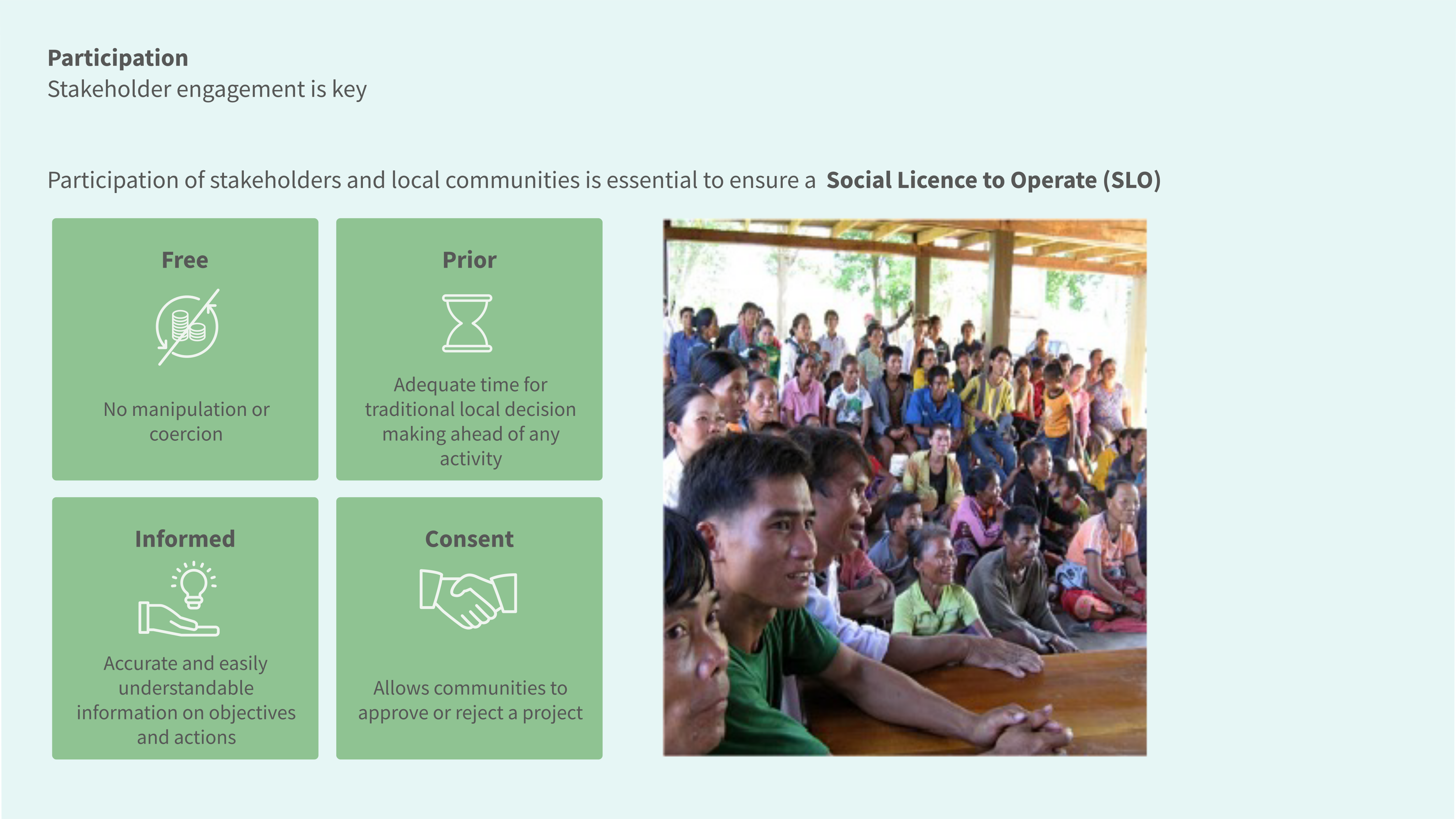
Source: International PtX Hub, illustration adapted from FPIC (2012), https://landportal.org/blog-post/2021/05/demystifying-fpic-tools-support-development-avoid-conflict-and-respect-community.
Figure explanation: Stakeholder engagement and the participation of affected local communities are crucial to ensuring the sustainability of Power-to-X projects. The UN Framework for Free Prior Informed Consent (FPIC), although initially developed for involving indigenous peoples, can also serve as a useful guide in the Power-to-X context:
Free Refers to consent that is given voluntarily and without coercion, intimidation or manipulation. It also refers to a process that is self-directed by the community
whose consent is being sought. Prior means that consent is sought in good time before authorisation or the commencement of activities, specifically during the early stages of a development or investment plan. Informed refers primarily to the nature of the engagement and the type of information that should be provided prior to seeking consent and also as part of the ongoing consent process. Consent refers to the collective decision of the rights-holders, taken through the customary decision-making processes of the affected communities.


