Preparing for e-SAF at scale
Introducing the PtX.CarbonRun
The aviation sector has largely answered the question of whether Sustainable Aviation Fuels (SAF) are necessary with a strong yes. Battery-electric aircrafts are being tested for short-haul routes, and purely hydrogen-powered ones for both short- and medium-haul. But for long-haul operations and the long time to market for these alternatives, hydrocarbon fuels are crucial. The question is if their non-fossil versions can be scaled fast enough. Global aviation currently consumes more than 300 million tonnes of jet fuel annually, with demand rising, while SAF production currently only supplies less than one percent of demand. The challenge is no longer to prove that SAF works technically, but to build a system that builds new supply chains capable of replacing fossil aviation fuels at global scale.
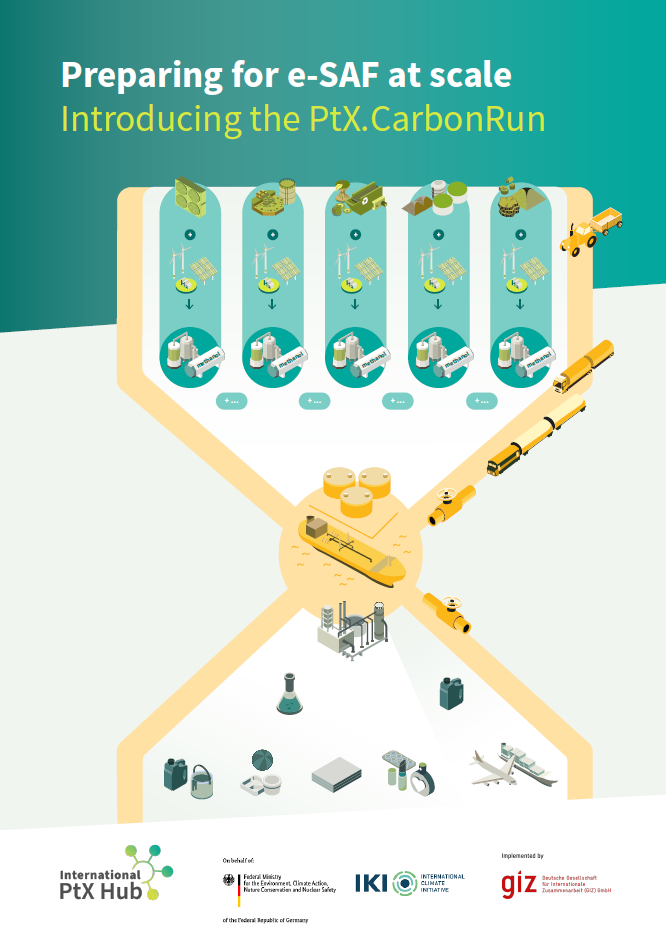
This impulse paper proposes the PtX.CarbonRun as a system to establish these new resilient supply chains. Rather than discussing the potentials of different fuel production technologies or feedstocks, the PtX.CarbonRun starts from a different observation: the future of sustainable aviation depends on mobilising vast quantities of renewable carbon from diversified and sustainable sources. Agricultural residues, forestry residues, biogas, sewage sludge, municipal waste, black liquor, other industrial biogenic carbon streams and, with sufficient economic viability, Direct Air Capture (DAC), i.e. carbon dioxide captured from the atmosphere, will all have a role to play. No single feedstock will be sufficient to satisfy the rising global demand for aviation fuels. Successful scaling of production therefore depends on creating a value chain capable of integrating many feedstocks into one common system.