Electricity
Electric power is the main input to Power-to-X production. Therefore, the origin of that electricity and its integration into the power system are decisive factors in determining its sustainability. Two characteristics are of key importance: renewability and additionality.
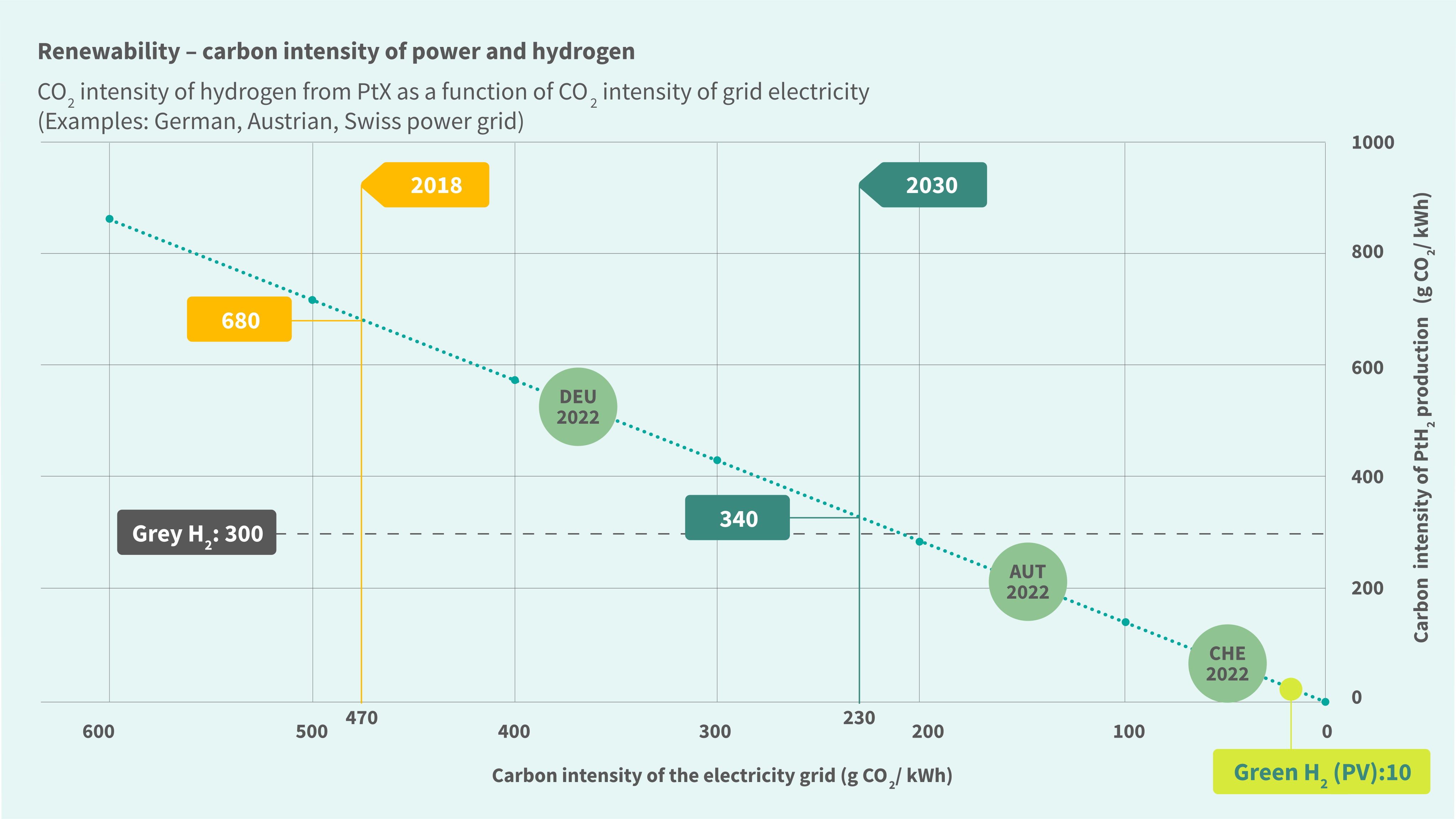
Renewability means that the electricity stems from wind, solar, hydro or geothermal energy, and not from fossil sources. The type of energy used to produce hydrogen and Power-to-X products has the strongest impact on its carbon footprint. Converting electricity into hydrogen and Power-to-X products inevitably leads to a loss of available energy. To produce 1 TWh of hydrogen, around 1.4 TWh of electricity is required – with significant variations, e.g. depending on the electrolyser full load hours. Accordingly, the greenhouse gas (GHG)-intensity embedded in hydrogen produced from water electrolysis will always be higher than that of the electricity used for its production, as seen in the figure and related explanatory note below.
Source: International PtX Hub (2021), own design, based on Öko-Institut (2019): Kasten, P. & Heinemann, C.: „Not to be taken for granted: climate protection and sustainability through PtX“, https://www.oeko.de/fileadmin/oekodoc/Impulspapier-soz-oek-Kriterien-e-fuels.pdf, p. 10.
Figure explanation: The contribution of Power-to-X (PtX) to climate mitigation depends crucially on two characteristics of the electricity used: renewability and additionality. This figure illustrates why it is important to use renewable electricity. On the vertical (y-)axis, it shows the carbon intensity of hydrogen from water electrolysis as a function of the carbon intensity of the type of electricity used, which is shown on the horizontal (x-)axis (from right to left). In both cases carbon intensity is measured in gCO2 equivalent per kWh. The dotted diagonal line indicates that due to conversion losses, the carbon intensity of hydrogen from water electrolysis is roughly 1.45 times higher than that of the electricity used to produce it. In 2018, the carbon intensity of the German power grid was 470 gCO2e/kWh. The carbon intensity of hydrogen, produced with this electricity was 680 gCO2e/kWh, which is more than twice as high as that of grey hydrogen produced with fossil gas (300 gCO2e/kWh). Even if – in accordance with an ambitious climate protection scenario – the German grid’s carbon intensity would come down to 230 gCO2e/kWh until 2030, the CO2 intensity of hydrogen from water electrolysis would still be at 340, thus, above the grey hydrogen reference level. The green circles show the carbon intensities of the German, Austrian and Swiss grids in 2022. Thanks to a high share of renewable (hydro) power, the Swiss grid has a low carbon intensity and would allow to produce low-carbon hydrogen from electrolysis. If hydrogen would be produced with electricity from a photovoltaic (PV) power facility only, its carbon intensity could be reduced to almost zero. This means: To contribute to climate protection, Power-to-X should rely on renewable electricity. Currently, in most countries and cases significant reductions in greenhouse gas intensity of hydrogen cannot be achieved with electricity from the power grid.
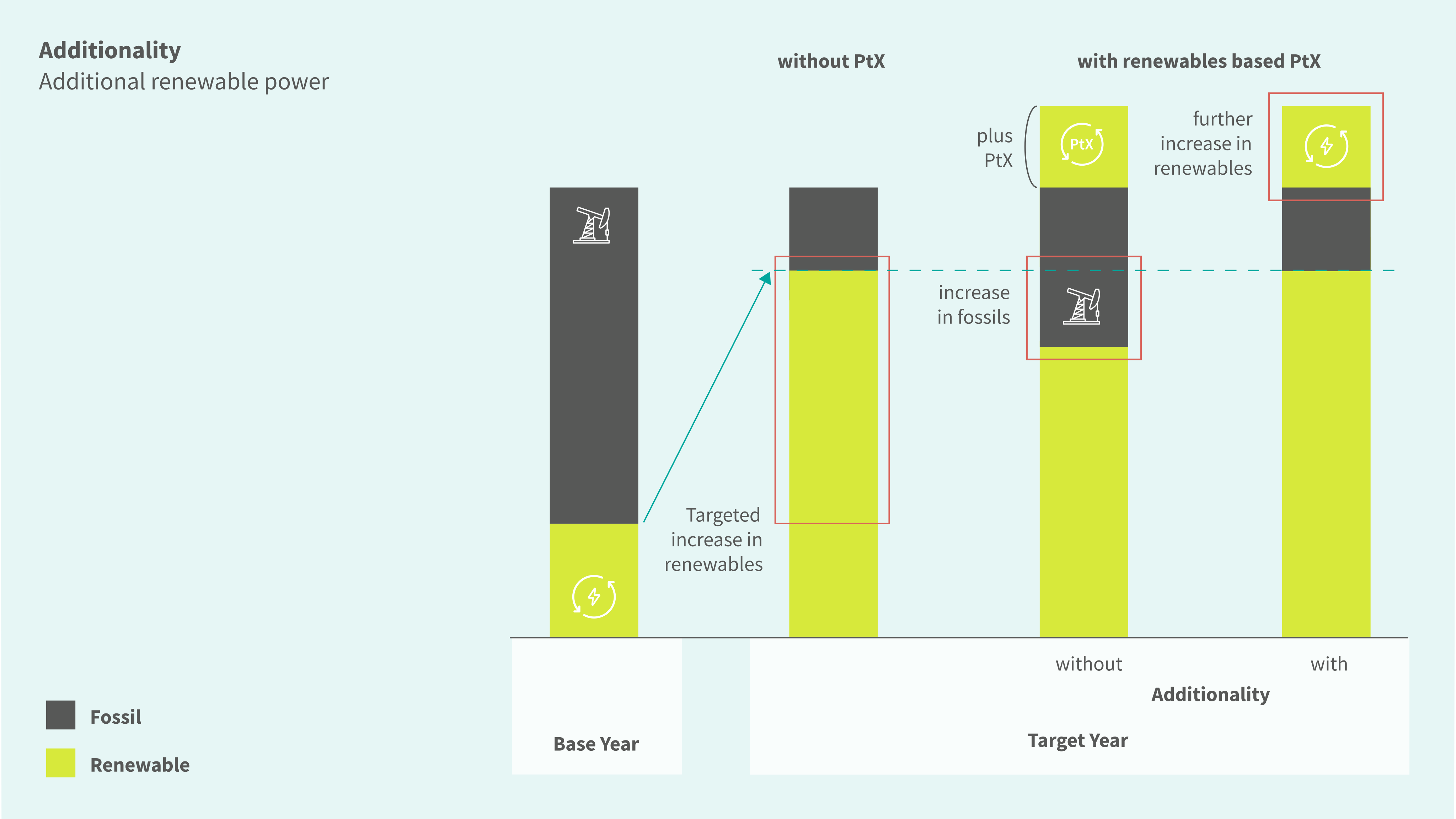
Additionality means that the energy used for Power-to-X production should stem from additional renewable electricity generation that is explicitly dedicated towards Power-to-X production. This is to ensure that Power-to-X production does not indirectly lead to an increase in fossil-based power use in other sectors, “through the back door”. To prevent this, regulation is needed ensuring that green hydrogen production does not divert renewable electricity away from the overall grid transformation. The figure below visualises why Power-to-X production should meet both conditions: renewability and additionality.
Source: International PtX Hub (2021), own design, based on Öko-Institut (2019): Kasten, P. & Heinemann, C.: „Not to be taken for granted: climate protection and sustainability through PtX“, https://www.oeko.de/fileadmin/oekodoc/Impulse_paper_criteria_for_e-fuel_production.pdf, p. 10.
Figure explanation: To be truly sustainable, electricity used for hydrogen and Power-to-X production must not only be renewable. It must also be additional. This graph explains why additionality matters. For the base year it shows the national power mix from fossil and renewable sources. For a given target year the share of renewables shall be significantly increased. If by that time Power-to-X shall be produced with renewable electricity there is a risk that this power will simply be diverted from other uses. If these other uses were then forced to switch to electricity from coal, oil or gas, PtX would effectively bring in fossil electricity “through the back door”. Thus, the Power-to-X power demand should be covered by additional renewable electricity in order not to undermine the already planned energy transition of the grid. Power-to-X production should not lead to an increase in fossil energy use. Power-to-X roadmaps must therefore be fully integrated into national energy and climate strategies such as the Nationally Determined Contributions (NDCs) under the Paris Climate Agreement.
In order to ensure that hydrogen and Power-to-X production is also not destabilising electricity grids, the EU has established further conditions of geographic and temporal correlation. These requirements apply to both domestically produced and imported products if they are to be sold as ‘renewable hydrogen’ or ‘Renewable Fuels of Non-Biological Origin’ (RFNBOs).
Carbon Cycle
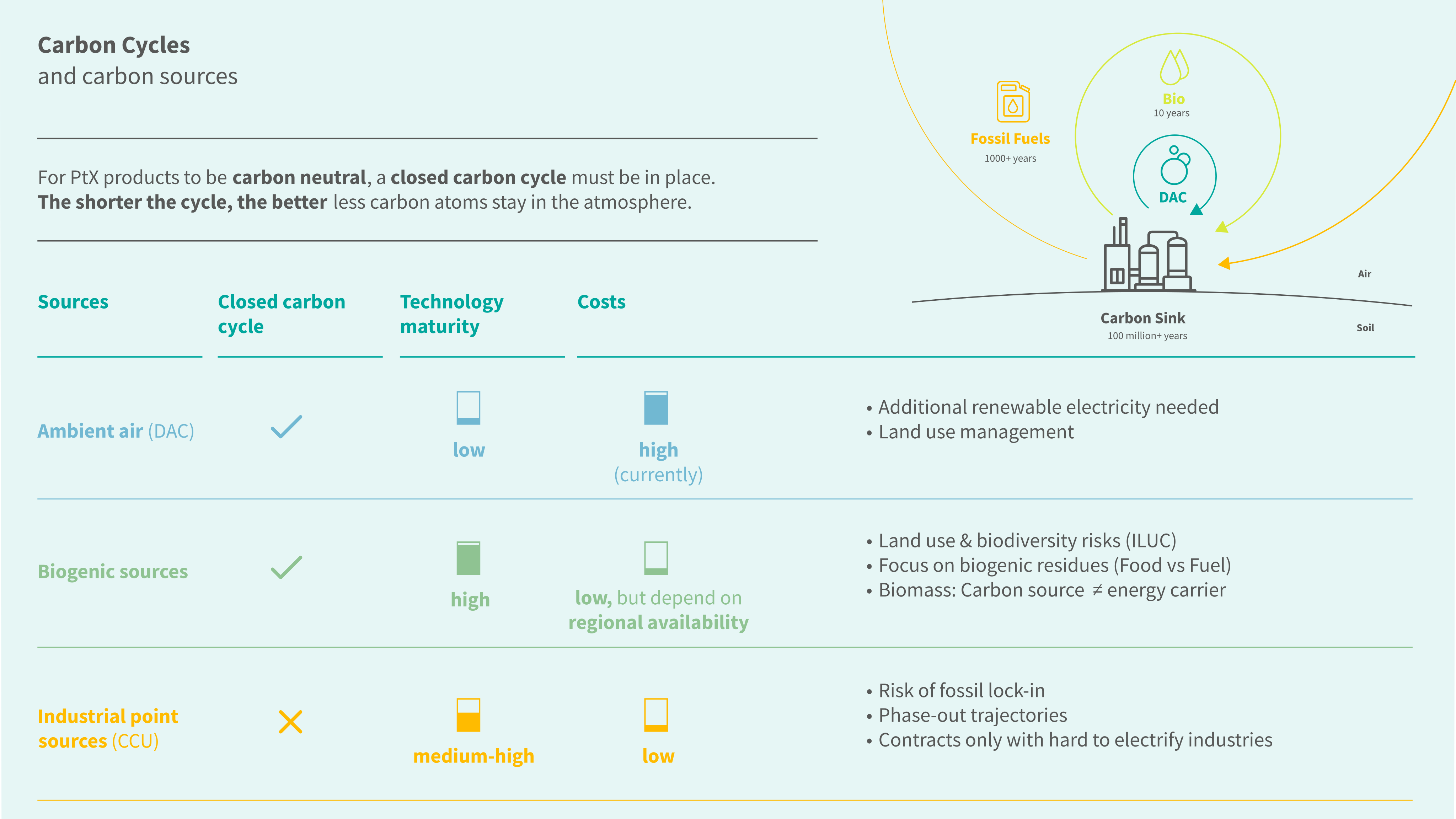
A carbon cycle describes the process by which carbon atoms are exchanged from the atmosphere to the earth and then back into the atmosphere. To produce a variety of Power-to-X products, such as methane, methanol, synthetic e- kerosene, carbon is a necessary input. Therefore, to produce sustainable Power-to-X products, this carbon must not add to the atmospheric accumulation of GHG. In a sustainable carbon cycle for Power-to-X products, carbon inputs are sequestered from the atmosphere, stocked in synthetic hydrocarbons like fuels, and then emitted back into the atmosphere when these synthetic hydrocarbons are combusted. This Power-to-X carbon cycle is closed and thus does not add to GHG accumulation in the atmosphere.
In general, three different types of carbon sources can be distinguished:
- Direct Air Capture (DAC) installations directly remove CO₂ from the ambient atmosphere;
- Biogenic sources, ideally from waste and biogenic residues; and
- Carbon Capture and Use (CCU) from hard-to-abate industrial point sources such as cement or steel plants.
Source: International PtX Hub, own illustration.
Figure explanation: For Power-to-X products that require a synthesis of green hydrogen and carbon, three different carbon sources can be distinguished: Direct Air Capture (DAC), biogenic sources, and industrial point sources. This figure summarises their respective characteristics, advantages and disadvantages: only DAC and biogenic residues can be considered carbon neutral and part of a closed carbon cycle. DAC captures carbon directly from the atmosphere, while the carbon contained in biogenic residues was originally absorbed from the atmosphere by plants through photosynthesis. In contrast, carbon captured from industrial point sources does not usually originate from a closed carbon cycle. In many cases, this carbon is fossil carbon derived from natural gas, oil, or coal. Unlike biogenic carbon, fossil carbon was not recently removed from the atmosphere. Instead, it is extracted from geological reservoirs and released into the atmosphere, thereby introducing additional carbon into the atmosphere. It should only be considered as a temporary option in early ramp-up phases of Power-to-X, coupled with clear defossilisation strategies. Whilst the scalability of DAC is high, technological maturity is still low and costs are high. Although capture and use of biogenic and industrial carbon is largely technologically mature, and the costs are comparatively low, scalability is limited, depending on local conditions. The most critical sustainability issues are: DAC: the need for additional electricity from renewable energy sources to power the DAC facilities; biogenic sources: direct and indirect land use changes and risks to biodiversity, as well as potential trade-offs with food security; industrial Carbon Capture and Usage (CCU): lock-in of fossil technologies and supply chains. For Power-to-X products to be carbon neutral, a closed carbon cycle must be in place.The shorter the cycle, the better, since less carbon atoms stay in the atmosphere.
DAC is regarded the best long-term solution. It ensures a closed carbon cycle. The availability of carbon from ambient air is evenly distributed across different regions and is not expected to decrease significantly in the long-term.
However, DAC is an energy-intensive process and also occupies significant amounts of land. Therefore, DAC should meet the same requirements as those for electricity: renewability and additionality. Currently, DAC technologies are still expensive and have not yet reached the level of technology readiness required for them to dominate Power-to-X production in the short term.
Biogenic carbon sources are biogas, bioethanol, solid biomass or fermented materials and waste streams. All these have captured carbon from the environment. However, the availability of biogenic sources is limited and unevenly distributed. For example, waste streams mostly occur in large cities, which might be far from available land for solar and wind parks. Moreover, biogenic carbon sources have a limited scalability and will not be able to satisfy future demand on their own.
They could however help to kickstart the Power-to-X market as it offers a sufficient level of technology readiness. It is important that the used biomass respects all the established sustainability criteria for biomass products, in particular with regard to land use and land use change. For example, cultivating biomass as carbon input for Power-to-X production should not compete with agricultural production for food and feed.
Industrial point sources using CCU technologies cannot be considered renewable since the carbon usually comes from fossil sources, meaning the carbon cycle is not closed, but brings more fossil carbon into the atmosphere. Reliance on CCU is risky since it may lead to a lock-in into fossil technologies that should be phased out. It might also create price incentives in favour of fossil-based processes. Still, CCU technologies are more energy efficient and have a higher level of technology readiness than DAC. It might therefore be a valuable option to use them for upscaling Power-to-X production but its application should be limited in time and to hard-to-electrify sectors.


