Water
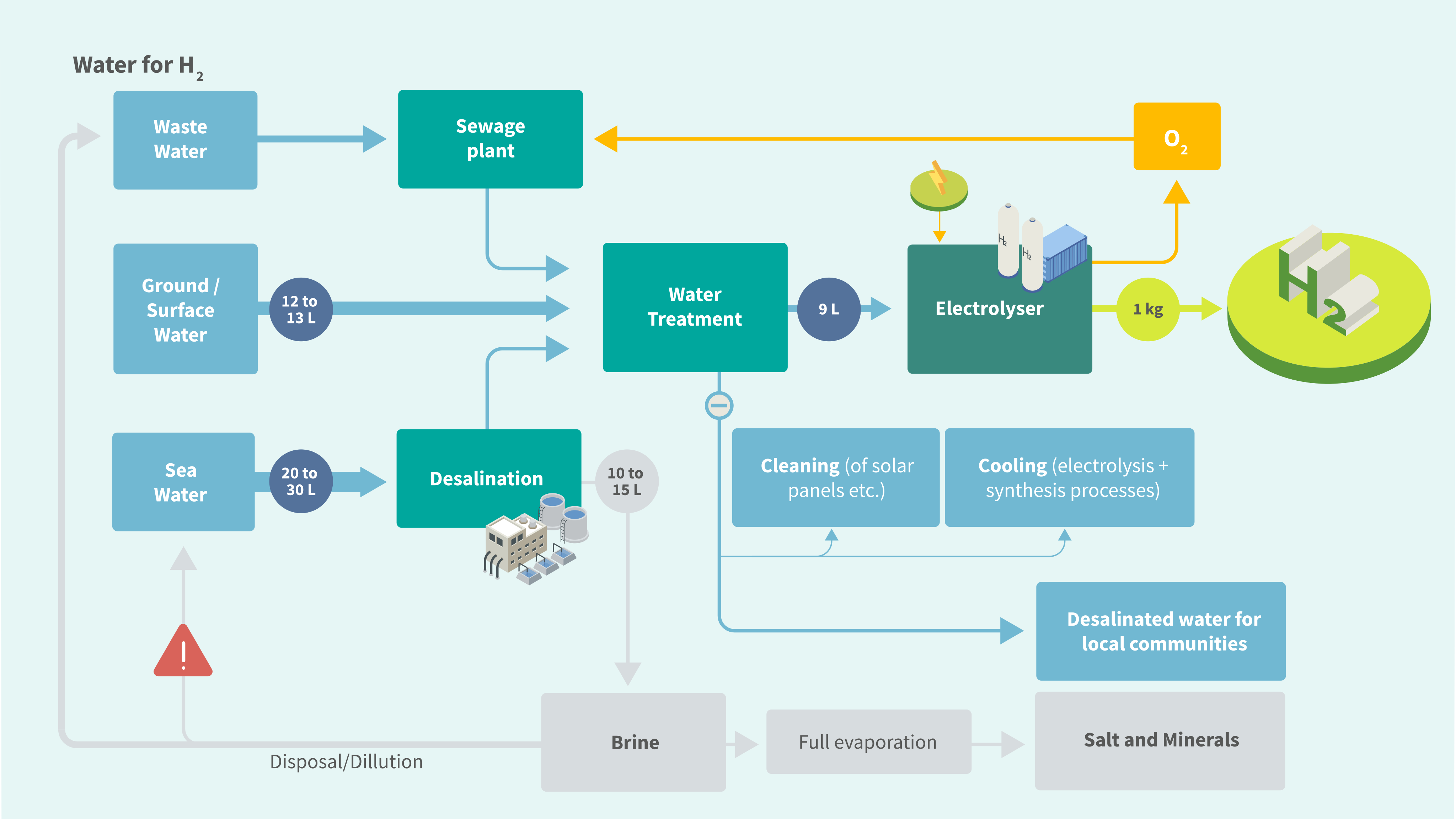
As one of the most important inputs for electrolysis, water is the very base of Power-to-X production. 1 kg of hydrogen requires approximately 9 litres of ultra-pure water. More water is needed for cooling electrolyser equipment and cleaning solar panels.
Nonetheless, Power-to-X has a significantly lower water footprint than fossil thermal power generation or blue hydrogen production. To meet the green hydrogen demand by 2050, IRENA estimates that only 0.3 % of the current freshwater consumption is needed.
Source: International PtX Hub, own illustration, inspired by DVGW (2023), https://www.dvgw.de/medien/dvgw/leistungen/publikationen/h2o-fuer-elektrolyse-dvgw-factsheet.pdf.
Figure explanation: The water demand for hydrogen and Power-to-X production is a key sustainability concern. In regions with excellent wind and solar potential for green hydrogen production, water is often a scarce resource. To produce 1 kilogramme of hydrogen from water electrolysis, 9 litres of pure water are required. If the water is sourced from ground or surface water bodies, it needs to be treated and purified, requiring 12 to 13 litres for 1 kilogramme of hydrogen. The water may also come from sewage plants that are treating wastewater. If well integrated, oxygen (O2) – a by product of hydrogen electrolysis – could be used to improve the effectiveness and efficiency of the sewage and water treatment plant. In water-stressed regions, water supply to hydrogen and Power-to-X facilities will often depend on desalination. For the case shown here (producing 1 kg of hydrogen), the required amount of sea water is around 20 to 30 litres. While financial costs of desalination are modest, environmental cost could be high. For every kilogramme of hydrogen, sea water desalination generates at least 10 to 15 litres of brine, a hyper saline liquid, often polluted with chlorine, copper and chemicals. If disposed into the sea untreated it can potentially create serious harm to aquatic eco-systems. However, several treatment options exist, which could extract valuable salt and minerals from the brine, producing saleable by-products. In addition to the electrolysis process water is also needed for cleaning PV installations or for the cooling in electrolysis and Power-to-X synthesis processes. Furthermore, it makes much sense to consider oversizing the desalination plant, thereby creating co-benefits for neighbouring communities and businesses. Such over-capacities can be generated with marginal additional costs. If covered by the investor, this would contribute to improving the project’s reputation and securing its social licence to operate (SLO). The extra costs could, however, also be covered by a Public-Private-Partnership (PPP), potentially supported by development cooperation funding.
Water stress is however a reality for many countries with high wind and solar power potential for hydrogen production. Desalination will be required here to avoid exacerbating water shortages. Like electrolysis, desalination is energy intensive, so the electricity used must meet the same standards regarding renewability and additionality.
Source: World Resources Institute (WIR Aqueduct): Aqueduct Water Risk Atlas 3.0, https://www.wri.org/applications/aqueduct/water-risk-atlas.
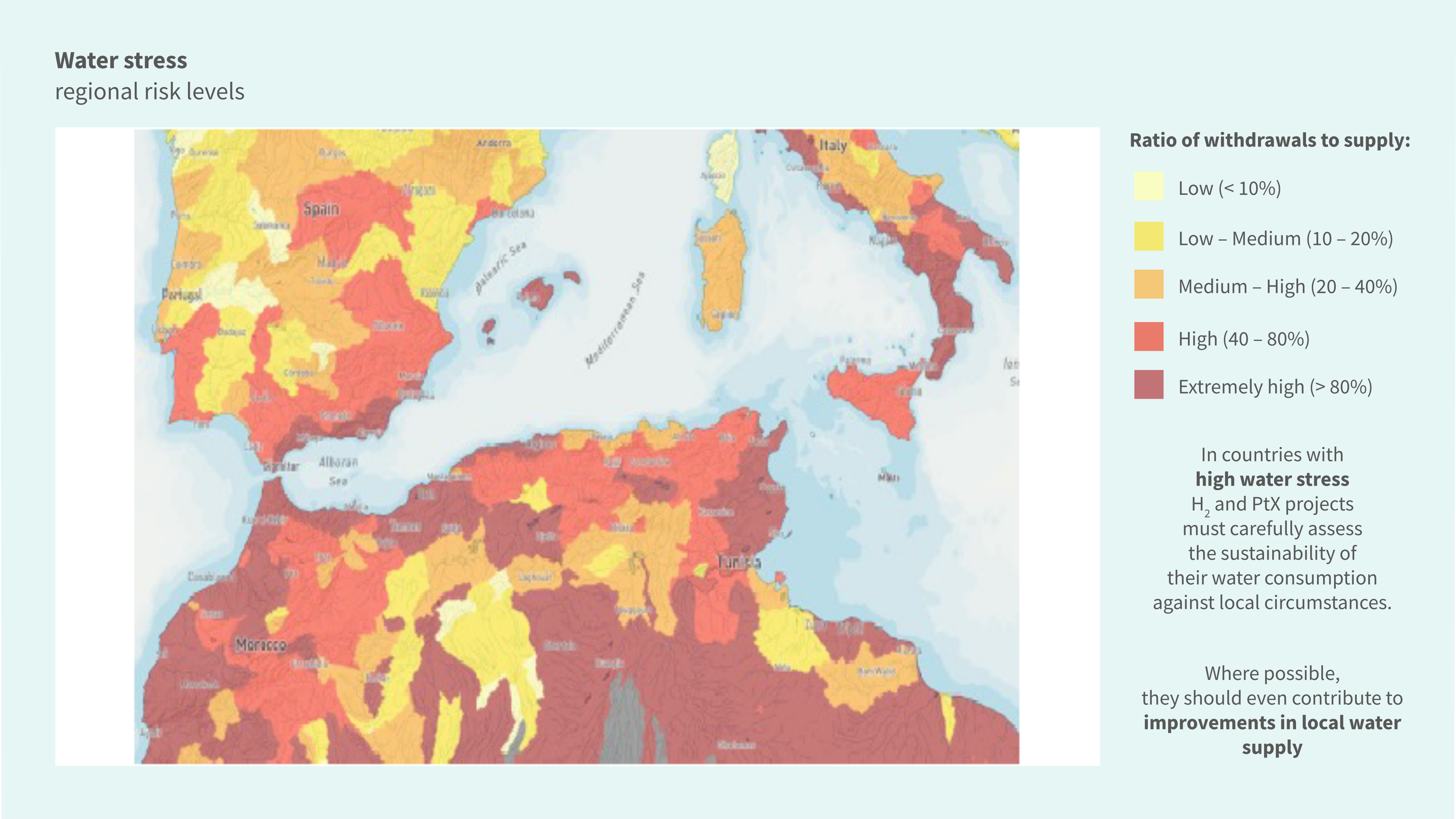
Figure explanation: Generalised global assessments of the water impact of hydrogen and Power-to-X production can be very misleading. Many regions, in particular in Africa, are already suffering from serious water stress. Even at the national level, withdrawals risk depleting the water supply already today. And climate change will further exacerbate water scarcity. To gain a realistic picture, a look beyond national averages is needed. Water demand must be assessed in its local circumstances. As can be seen from the more granular water risk map of the Western-Mediterranean Sea, local water stress levels can be very high. Therefore, in these regions, any investment in water infrastructure should aim also at improving local water supply. In this context, desalination can play a significant role.
The additional desalination costs for hydrogen production are marginal. Therefore, Power-to-X projects should systematically consider the potential co-benefits of alleviating water stress for local communities by providing water for households, as well as to industrial and agricultural activities.
However, desalination raises serious environmental issues, particularly the disposal of brine, a highly saline liquid polluted with chlorine, copper and chemicals. Discharging brine directly into the sea or into fresh waters has negative impacts on aquatic ecosystems. Proper treatment and impact assessments are therefore required.
Land and Biodiversity
Power-to-X production plants themselves don’t require much space – the electricity facilities that power them do, however. Moreover, in lifecycle assessments, Power-to-X products have a larger land use footprint due to their lower energy efficiency compared to using electricity directly where it is possible (e.g. battery-electric cars).
While some areas are less constrained in terms of available land, particularly in arid regions, there are still land use-related environmental implications that should be analysed when new installations are put in place.
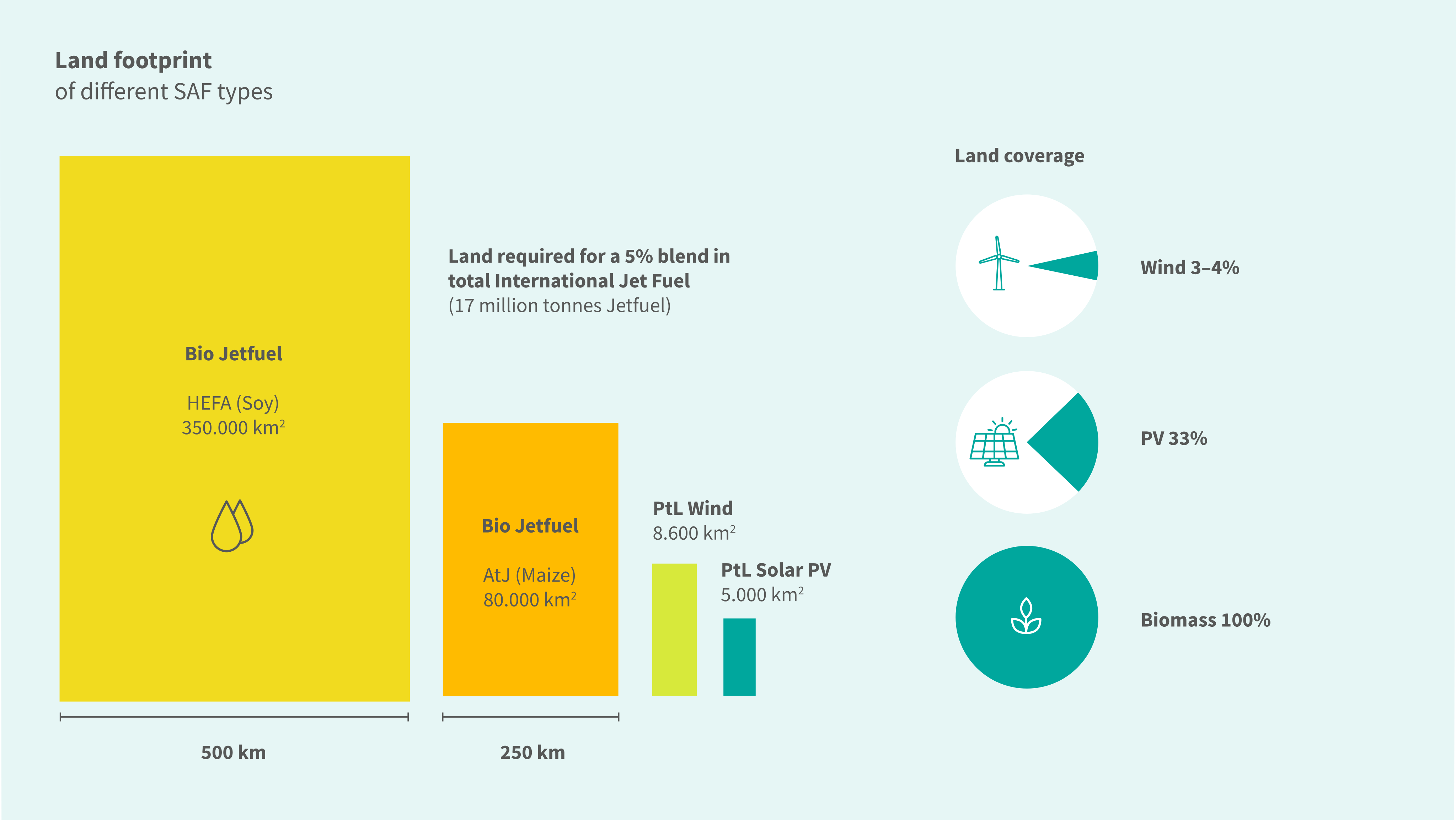
A comparison of the land footprint of different Sustainable Aviation Fuel (SAF)-types (see figure below) shows that Power-to-X jet fuel from solar PV uses 70 times less land than biofuel production.
Source: International PtX Hub (2021), own illustration. Calculations based on UBA (2016).
Figure explanation: As with water, hydrogen’s land footprint is a major environmental concern, particularly because direct and indirect land-use changes often have adverse impacts on biodiversity. It is not so much the hydrogen and Power-to-X production facilities that matter, but the extension of the connected wind and solar power installations that are commanding many hectares and square kilometres. This footprint should however be set in context. This figure shows the land area required for the production of different Sustainable Aviation Fuels (SAF), that would be needed for a 5% blend in total international jet fuel consumption (17 million tonnes). Currently, most SAF is from biofuel: HEFA (Hydroprocessed Esters and Fatty Acids) or AtJ (Alcohol-to-Jet). HEFA, for example from soybeans, would need an area of 350.000 km2, about the size of Germany. Bio jet fuel produced with Alcohol from Maize (ethanol) has a footprint of about 80.000 km2, which is more than the size of the Benelux countries together. In contrast, Power-to-Liquid jet fuels need much less land: wind-based PtL: 8.600 km2 and for solar PV-based PtL: 5.000km2. The actual footprint of renewable Power-to-Liquid fuel is even lower, considering that crops for biofuels cover the entire land area. For PV, only about 30 % is occupied by solar panels, and wind turbines cover less than 5%. Farmers can still use the land in between solar panels and wind turbines for grazing animals or even for sophisticated, integrated dual land use systems often called „agrivoltaics“. They can even create beneficial conditions for certain types of crops or vegetables, e.g. by providing shade Nonetheless, in many cases serious land use conflicts remain and must be solved or brought to an agreed solution.
Land use changes might also have biodiversity impacts. In most cases, Power-to-X interference with landscape ecology and species diversity is less severe than the impacts of biomass production for biofuels. Wind turbines are however risky for birds and bats. Offshore wind parks can also interfere with marine ecosystems.
Huge installations can fundamentally alter habitats, not only ecologically. They can also infringe upon cultural heritages and identities by altering the appearance of landscape amenities.


