Resources for Renewables
A global energy transition to renewables is likely to cause a steep increase in the use of critical raw materials. Power-to-X technologies require iridium, platinum, tantalum, cobalt, and nickel for electrolyser equipment. Not only are these materials scarce, but they are also hard to replace through innovation in electrolysis. Furthermore, they are often produced under conditions exposed to human rights violations.
Another inherent challenge is the global dependency that critical raw materials bring with them. Mining of critical raw minerals is highly concentrated on only a few countries (see figure below). An example is that South Africa is controlling 92% of the production of platinum. 64% of cobalt is coming from the Democratic Republic of Congo. What matters even more than mining is the processing and beneficiation of the minerals. A look at the processing shares reveals the strong dependence on China, which controls more than 50% for lithium, over 60% for cobalt and almost 90% for rare earth elements.
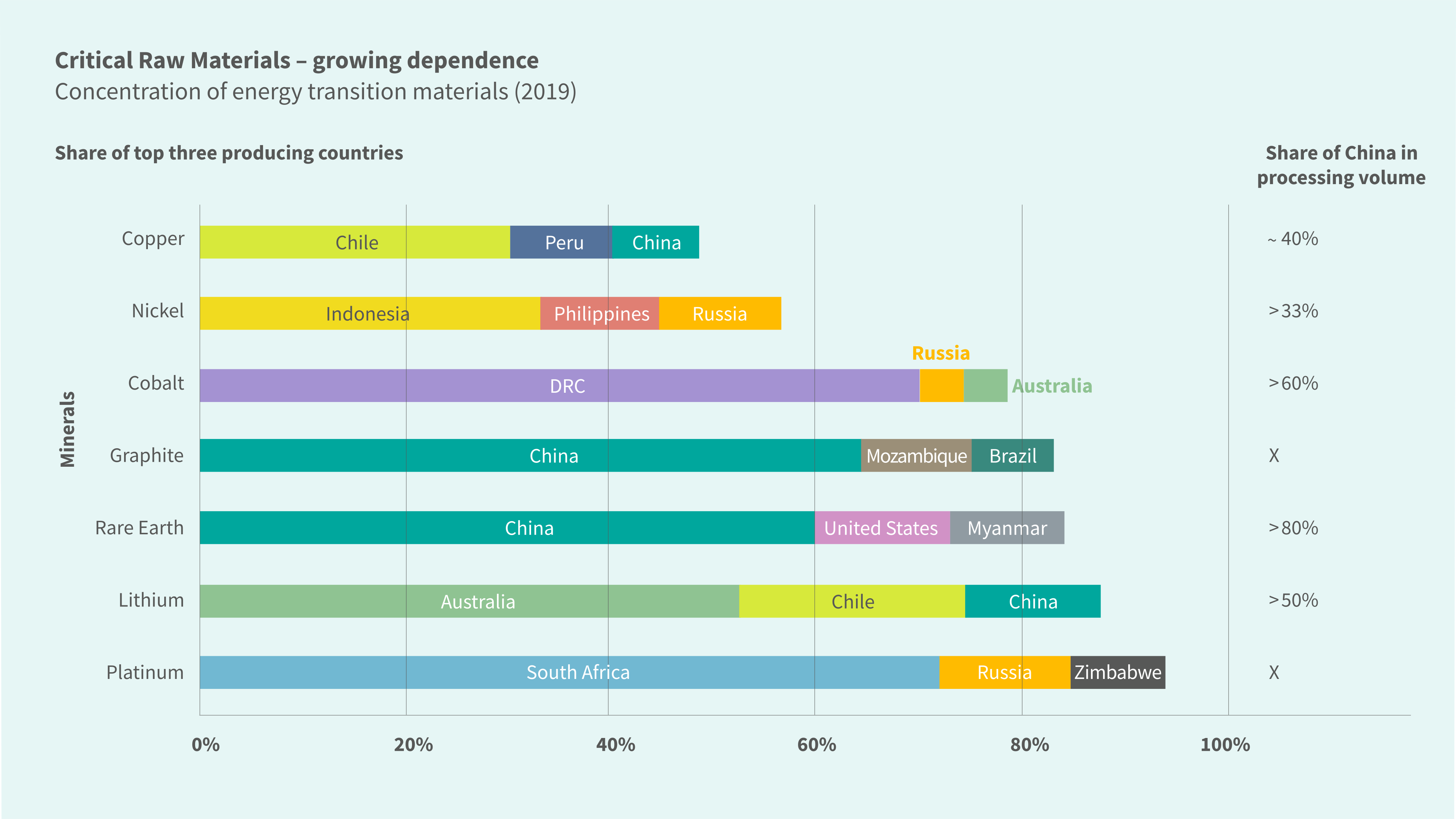
Source: International PtX Hub (2021). Illustration adapted from IEA (2021): The Role of Critical Minerals in Clean Energy Transitions, https://iea.blob.core.windows.net/assets/24d5dfbb-a77a-4647-abcc-667867207f74/TheRoleofCriticalMineralsinCleanEnergyTransitions.pdf.
Figure explanation: The figure illustrates the high territorial concentration of critical raw materials required for the energy transition. They are needed for wind and solar PV installations as well as for electrolyser and synthesis equipment. The graph shows the shares of the top three producing countries, for some minerals reaching more than three quarters of global production. One should, however, look beyond mining. In many cases, China is dominating the processing of minerals, even those that stem from African or Latin American countries. This strategic dependency is creating a serious risk to supply chain resilience and sustainability.
Recycle and Redesign
There is the critical risk that the future demand for some raw materials, for example iridium, might exceed the actual available amount of it.
There are three strategies to avoid such supply-chain bottle necks: prevention, extension and recycling. It is estimated that these strategies, together with technological improvement of electrolysers, could by mid-century almost completely reduce iridium demand and platinum content.
Prevention means reducing or substituting the use of raw materials in the production process. This might include a thinner layer of coating material or simply using a mix of different technologies that demand less raw materials.
Extension considers the lifetime of a certain technology. By building more durable electrolysers and improving process efficiency, the productivity of raw material components increases, reducing the need for new resources.
Recycling, reuse, and refurbishment also play important roles in limiting and meeting future demand for minerals.


