In order to capture the benefits which Power-to-X production could bring to countries and communities, it is necessary to look beyond traditional economic performance measures, like Gross Domestic Product (GDP). Analyses should be complemented with additional information on income and wealth distribution as well as indicators of other material and non-material living standards.
Value Added
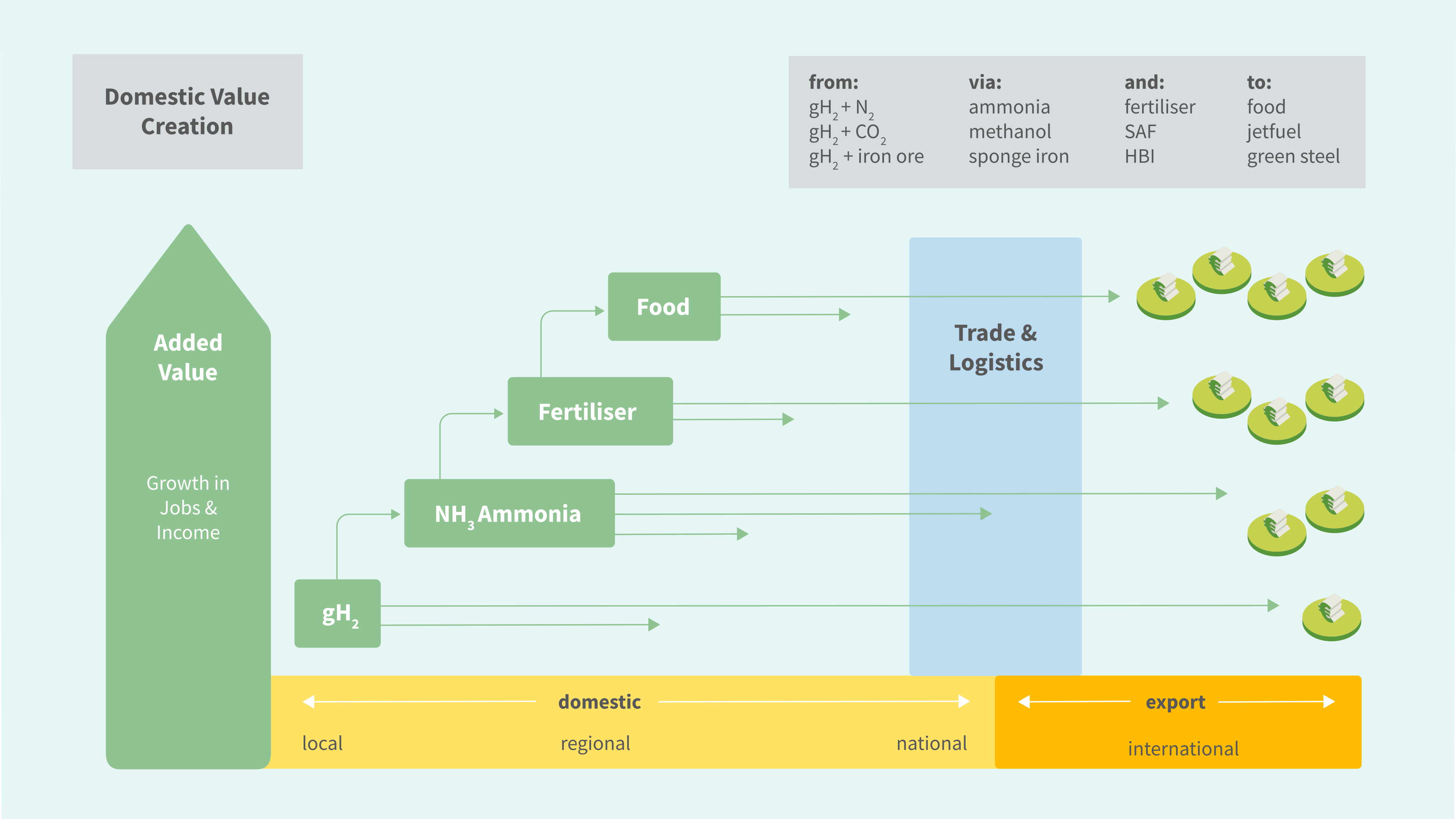
Developing a sustainable Power-to-X economy means looking beyond simply exporting just hydrogen. Wherever possible, further domestic value addition at local, regional and national level should become a priority. Like this, additional Power-to-X value creation would contribute to growth in jobs and income.
Take the example of processing hydrogen into ammonia. This could be used domestically, exported at a higher price and also be used in logistics as marine transport fuel. Ammonia is also the base chemical for nitrogen fertiliser production, and finally, this could stimulate food production and high value agricultural trade.
Like for ammonia, similar added value chains building on hydrogen could be developed for methanol and jet fuel or for iron sponge and green steel. Such an upgrading would generate prosperity through additional jobs and income.
Source: International PtX Hub, own illustration.
Figure explanation: Adding value – creates jobs and income. The hydrogen debate is often focussing on export and import opportunities. However, to develop a sustainable Power-to-X economy not only in producing countries but also in importing economies it is essential to pay careful attention to opportunities for additional value creation that can contribute to job and income growth. Domestically, hydrogen, can either be used directly or further processed to ammonia, through Haber Bosch synthesis, combining hydrogen with nitrogen. This increases the economic value of the product, and the production process generates income and employment. Ammonia can then also be exported, but it could also be used as a shipping fuel. Again it could be used domestically or further processed, e.g. to produce fertiliser, and finally, all kinds of feed and food products, again for domestic use or for export. In any case, the economic value, not only measured in monetary terms but also concerning strengthened local and national productive networks, will be significantly higher. The process of adding value will lead to employment creation and new streams of private income and public revenue. Similar options for expanded Power-to-X value chains building on hydrogen are e-methanol or Sustainable Aviation Fuels (SAF) or Sustainable Marine Fuels (SMF) for shipping. For steel making, using hydrogen to produce sponge iron – an intermediate input for producing higher value steel products – can open interesting economic perspectives benefitting not only exporting countries but also importing steel production economies.
It is important that Power-to-X production is well integrated into local productive networks to create local economic value and jobs. This will also trigger positive economic impulses through upstream and downstream linkages to related manufacturing and services branches, inducing regional multiplier effects.
Decoupling
From a climate and sustainability perspective, it is crucial to gradually decouple GDP growth from energy consumption and greenhouse gas emissions. “Weak decoupling”, whereby GHG intensity per unit of output declines only in relative terms is not sufficient. To reach carbon neutrality, “strong decoupling” with absolute emission reductions must be achieved.
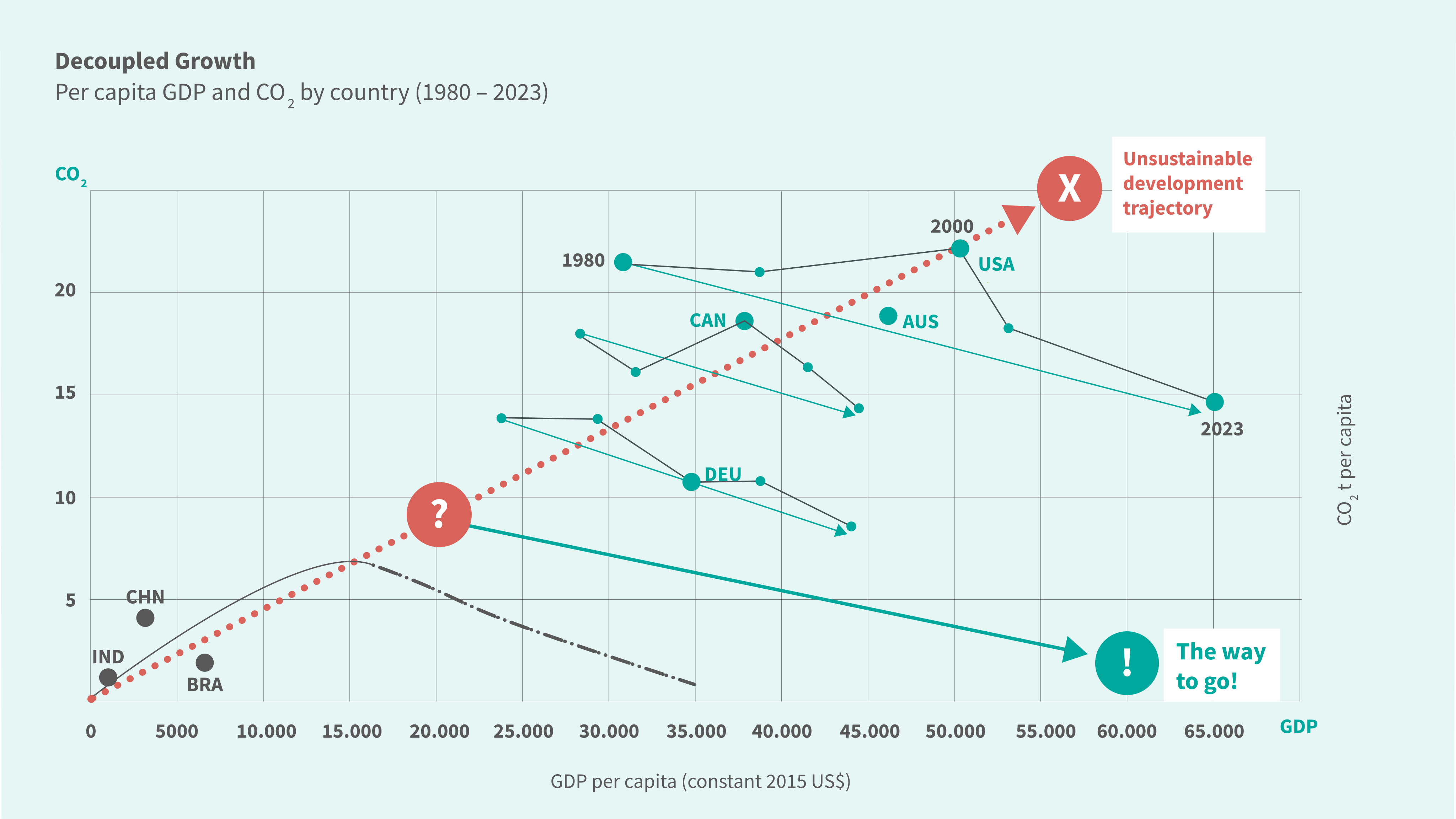
While cross-country comparisons seem to suggest that growth in GDP and GHG emissions are highly correlated, closer analysis of timeseries data by country shows that since 1980 GDP growth decoupled from CO2 emissions in most developed economies, including the USA and Germany and that decoupling can also be achieved at lower levels of GDP per capita.
Source: International PtX Hub, own illustration inspired by Michael Grubb (2014): Planetary Economics. Data from: https://ourworldindata.org/co2-and-greenhouse-gas-emissions and https://data.worldbank.org/indicator/NY.GDP.PCAP.KD.
Figure explanation: This figure aims to debunk a widespread misconception that increases in economic performance (Gross Domestic Product (GDP) are closely correlated with increasing Green House Gas (GHG) emissions (measured in CO2 equivalents). At first glance – if one considers only the data from the year 2000 – this seems obvious. Highly developed industrialised countries, such as the US, Canada, Australia or Germany, are positioned in the top right corner with high GDP and high GHG emissions per capita. Developing emerging economies, such as India, Brazil or China, are still in the bottom left corner with low GDP and low GHG emissions per capita. If their development trajectory were to follow the dotted diagonal line, this would lead to significantly increased GHG emissions. Fortunately, looking at trends in highly industrialised developed economies (between 1980 and 2023) one can observe a clear decoupling tendency. Whilst economic prosperity continued to grow, GHG emissions remained stable and have even fallen since 2000. Thus, in the graphic, the development trajectories of emerging economies, should not be directed towards the top right but to the lower right corner. Increasing economic prosperity should be accompanied by falling CO2 emissions. This decoupling is the way to go. The dotted curve describes the „leap-frogging“ over fossil-based development phases, which would be coherent with a sustainable development pathway.
Therefore, for developing countries and emerging economies, hydrogen, and Power-to-X in particular, may offer great opportunities for leapfrogging over fossil and energy intensive stages of economic development.
Local Productive Networks
It is important that the Power-to-X production is well integrated into local productive networks to create local economic value and jobs. This will also trigger positive economic impulses through upstream and downstream linkages to related manufacturing and services branches, inducing regional multiplier effects.
Lastly, it is essential to avoid the so-called “resource curse” or “Dutch Disease”. This occurs when a country fails to benefit fully from exploiting and exporting abundant natural resources. Distorted currency exchange rates can then create competitive disadvantages for other economic sectors. Related risks include the lack of strategic investment of revenues, illicit financial flows and a lack of transparency.


