Power-to-X sustainability assessments will have to consider the energy mix of countries, the level of diversification and dependence as well as their domestic or foreign origins.
In many countries considered as future hydrogen and Power-to-X powerhouses, renewable energy currently accounts for only a minor fraction of their total power generation. To make Power-to-X production sustainable, in many cases that requires a more fundamental transformation of the energy mix and efforts to fulfil the commitments under the Paris Climate Agreement.
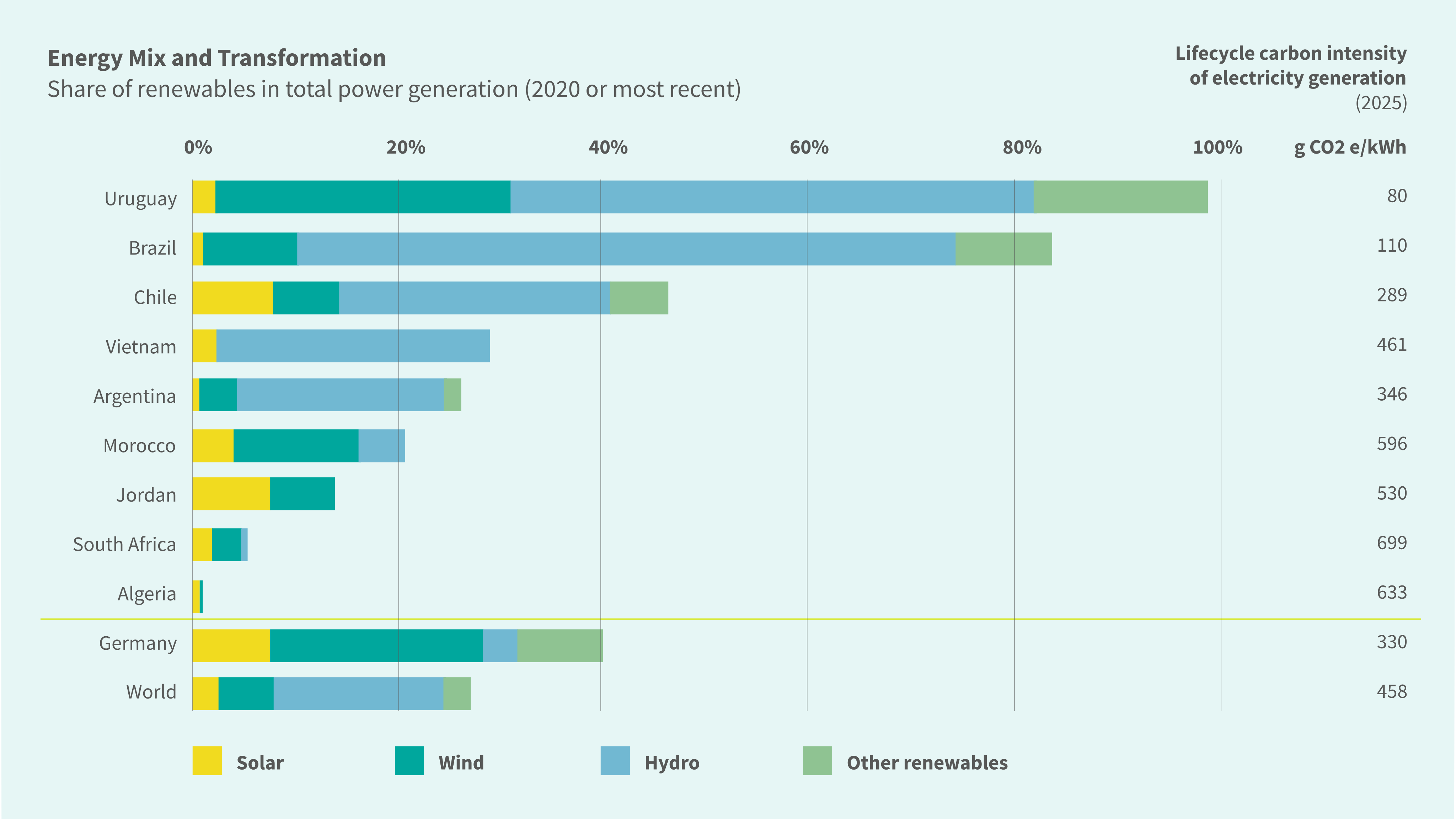
Source: International PtX Hub (2021), own illustration using data from Our World in Data. https://ourworldindata.org/grapher/share-electricity-renewables and https://archive.ourworldindata.org/20260518-090244/grapher/carbon-intensity-electricity.html?tab=table.
Figure explanation: Renewable hydrogen and Power-to-X production should not undermine national efforts to achieve the energy transition. On the contrary, Power-to-X should be integrated into national energy and climate strategies that aim at shifting the energy and power mix towards renewables. In particular for hydrogen and Power-to-X trade, the energy mix of the exporting countries should be considered. This figure shows a selection of countries currently considered as potential Power-to-X exporters. Uruguay and Brazil already have renewables shares of more than 80 % in their power mix. This is more than twice as high as in Germany and even three times higher than the global average. Shares for Chile, Vietnam or Argentina are in the range of 20-30 %. Another indicator for the state of transformation is the lifecycle carbon intensity of electricity generation (measured in gCO2e/kWh). Whilst the global average is in the order of 450 gCO2e/kWh, Uruguay, Brazil and Chile are below 300, mainly thanks to their large shares of hydro power. South Africa and Algeria are above 600 gCO2e/kWh and thus, still at a very early stage of transitioning towards renewable power generation. For all countries, their hydrogen and Power-to-X pathways should be aligned with overall strategies for a Just Energy Transition, that promote the expansion of solar and wind power capacities.
From a transformation perspective, attention should be paid to three independent design dimensions for a reliable and resilient PtX ecosystem:
- Both centralised and decentralised approaches;
- both modular and monolithic plant design concepts;
- both large and small production volumes.
Constraints in feedstocks (electricity, water, carbon) are obvious design parameters. Moreover, it is important to take the local communities’ participation and development into account.


