Sustainable Development Goal 7 of “Ensuring access to affordable, reliable, sustainable and modern energy for all” is particularly relevant, given the high electricity demand for electrolysis, but also for Direct Air Capture (DAC). This could hinder developing countries’ efforts to eradicate energy poverty, given that populations are growing rapidly, and energy access rates are improving at slower pace.
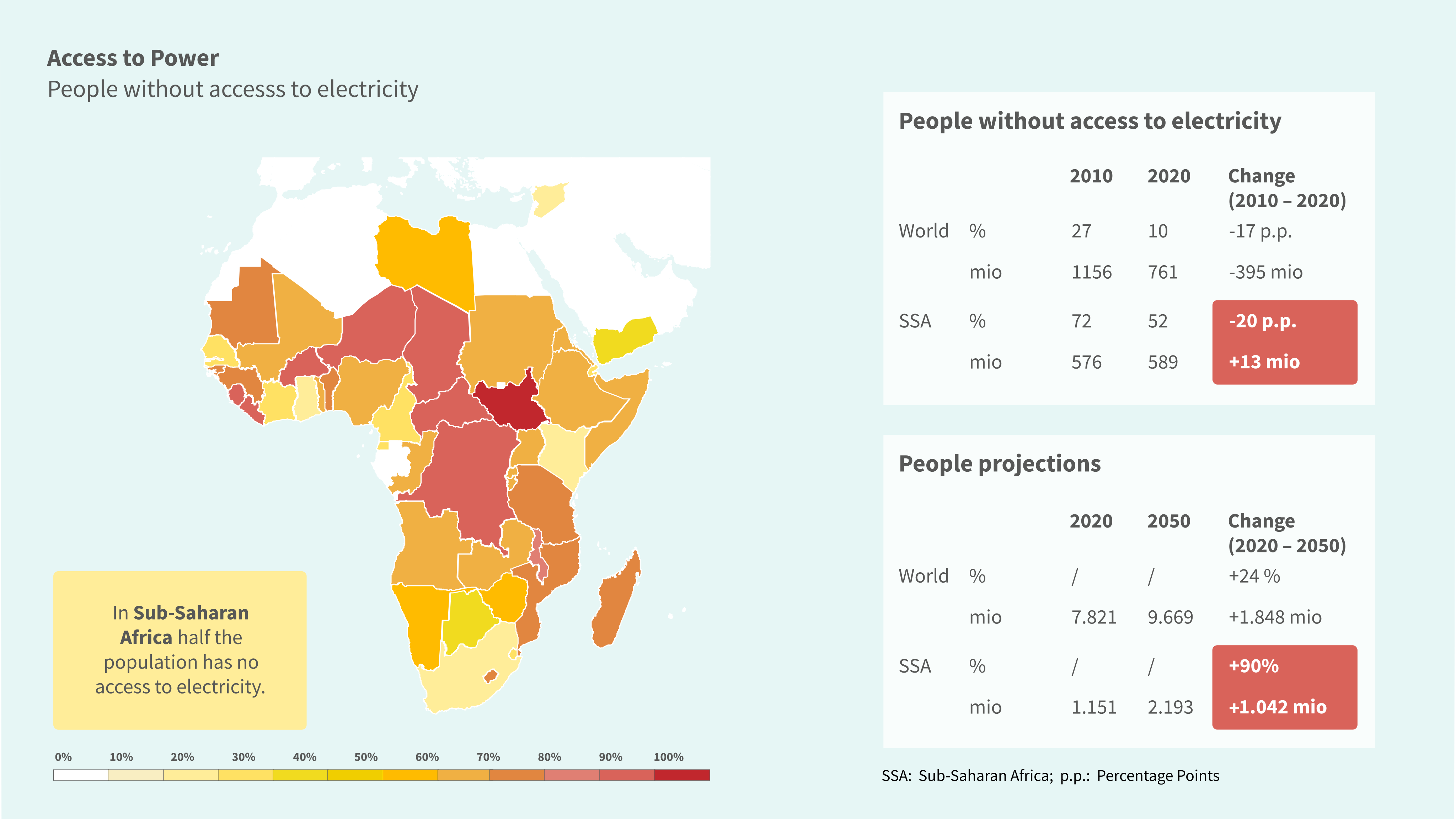
Source: International PtX Hub, own illustration. Data and map from Our World in Data, Access to Electricity (2022).
Definition: Access to electricity means having an electricity source that can provide very basic lighting and charge a phone or power a radio for 4 hours per day.
Figure explanation: Ensuring universal access to affordable and clean energy is a key social goal of sustainable development (Sustainable Development Goal 7). Today, however, around half the population of Sub-Saharan Africa (SSA) (600 million people) still lacks access to electricity. Although between 2010 and 2020, the proportion of people without access fell by 20 percentage points (p.p.) (from 72 to 52 per cent). Nevertheless, the number of people without electricity rose by 13 million, due to population growth. This is worrying against the backdrop of an expected population increase of 90 % until 2050 (from 1.2 to 2.2 billion people). Exporting electricity-based hydrogen and derivatives whilst large parts of a population still lack access to electricity cannot be regarded as sustainable development. Therefore, wherever possible, hydrogen projects should help to improve power supply to local communities.
It could also trigger or exacerbate conflicts over the resources needed to produce the demanded renewable electricity for PtX production. Thus, property and user rights – e.g. including customary grazing rights not formally documented – must be respected.
Sustainable Development Goal 6 “Ensure availability and sustainable management of water and sanitation for all” is also highly relevant. In many countries with Power-to-X potential, access to safe drinking water is limited. Power-to-X projects should not aggravate water shortages but rather help to alleviate water stress through investment and management efforts. One way to achieve this is to promote synergies between desalination plants and the water supply for local communities.
Early engagement with stakeholders and local communities, when designing Power-to-X projects, is therefore critical to raise acceptance and support ownership. This is also relevant in terms of project implications for land use. In many countries, the development of wind and solar parks faces opposition from local populations. These interferences should be taken seriously and addressed through early involvement.


