Like for any other business, Power-to-X project operators must respect fundamental human rights and core labour standards. These are defined by e.g. the UN Guiding Principles on Business and Human Rights (UNGP), the ILO Core Labour Standards, and the OECD Guidelines for International Enterprises and their Due Diligence Guidances.
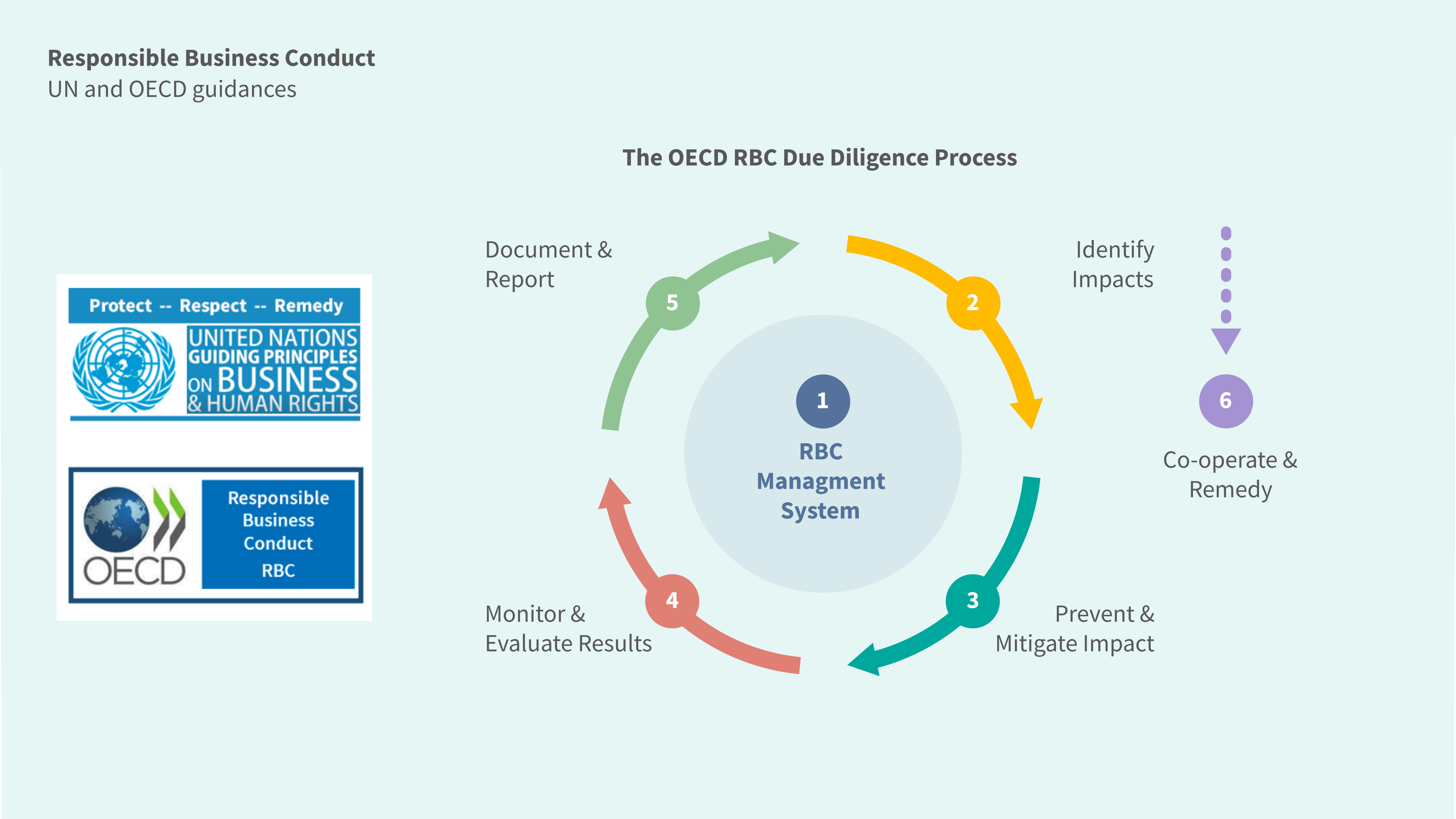
Source: International PtX Hub, illustration adapted from OECD (2018) ”OECD Due Diligence Guidance for Responsible Business Conduct”, p.21, https://doi.org/10.1787/15f5f4b3-en and U.N. Human Rights Council (2010) “The UN ‘Protect, Respect, and Remedy’ Framework for Business and Human Rights“.
Figure explanation: Key international reference documents for ensuring responsible business conduct (RBC) are the UN Guiding Principles on Business and Human Rights implementing the three pillars UN Framework: Protect – Respect – Remedy, as well as the OECD Guidelines for Multinational Enterprises in combination with the OECD Due Diligence Guidance for Responsible Business Conduct (RBC).
The RBC Due Diligence Process comprises six steps:
(1) Embedding RBC in the company‘s policies and management systems,
(2) Identifying actual or potential adverse impacts on RBC issues,
(3) Ceasing, preventing or mitigating these impacts,
(4) Monitoring implementation and outcomes,
(5) Communicating how impacts are being addressed; and
(6) Cooperating in remediation where necessary.
Protection of labour rights must be ensured at every step of the value chain. That means no forced or compulsory labour, child labour or any form of discrimination, particularly against women. It should also be guaranteed that companies respect the freedom of association of workers and their right to collective bargaining.
Establishing whistle-blower channels and grievance mechanisms for raising complaints can help reduce those risks.
Breaching these international standards implies not only reputational risks. Both national and EU legislation is becoming increasingly demanding with respect to supply chain due diligence. Legal sanctions have been established for companies ignoring these norms of responsible business conduct.


