of the tool Take a tour
PtX.Sustainability – The EESG Framework
The EESG Framework is a conceptual tool for organising assessments of the sustainability of Power-to-X across four dimensions: Environmental, Economic, Social and Governance.
Within each dimension, a wide range of sustainability aspects are grouped into four clusters of concern and opportunity. The framework distinguishes 16 clusters in total.
The framework facilitates structured analyses, discussions and an overall understanding of the comprehensive sustainability aspects related to Power-to-X, both at different levels (products, projects, processes and policies) and at various stages throughout the entire Power-to-X value chain (from inputs to production, synthesis, storage, transportation and final use). The framework emphasises that sustainability must be addressed holistically, going beyond carbon accounting and climate performance to also include socio-economic development, environmental integrity and governance capacity.
This interactive version allows you to explore the dimensions and topics in more detail. This version is based on the EESG Framework as developed in 2022 in this Scoping Paper. The framework has also been translated into an online checklist for project developers.
Environmental Dimension
Checking the environmental footprint of Power-to-X is essential for any sustainability assessment. Along the Power-to-X value chain, many environmental topics require attention. It starts with the energy sources for electricity generation and chemical syntheses, water supply for green hydrogen production, and land use for storage and transportation. Environmental resources are necessary for producing green hydrogen and Power-to-X. Therefore, to ensure the long-term viability of Power-to-X production, the integrity of ecosystems and biodiversity must be preserved.
Energy and Carbon Cycle
Water, Land and Biodiversity
Resources and Recycling
Pollution and Safety
Economic Dimension
Transforming the global energy system from fossil fuels to renewable sources will have groundbreaking economic implications. This transition presents major challenges. Yet, it also offers great opportunities for sound economic development, inclusive growth and prosperity. The energy transition will not only alter industrial production structures but also consumption, heating, transport and logistics patterns.
Supply and value chains will be modified, with consequences for global economic and geo-political balances and dependencies. The distribution of added value and wealth will be affected within and across countries as well as among societal groups. Any sustainability assessment of projects, partnerships and policies promoting hydrogen and PtX must therefore pay due attention to economic impacts.
Thus, this framework suggests broadening the focus of standard ESG reporting for sustainable finance and investment analyses to an EESG perspective incorporating economic opportunities, concerns and impacts as integral parts of sustainability evaluations.
Value Added and Decoupled Growth
Energy Mix and Transformation
Trade and Technology Transfer
Investment and Public Finance
Governance Dimension
Energy policy must always consider not just technological or economic aspects, but also geopolitical governance and security implications of the energy supply and demand. This is particularly pertinent in times of a fundamental transformation of the global energy system, as it alters trade relations and mutual dependencies that are shaped by fossil energy markets. This is the first time that countries have the real possibility of decoupling from fossil dependencies altogether.
The transition towards renewable energy and the emergence of a global hydrogen and Power-to-X market will lead to major power shifts, not only towards green electric power but also with implications for geopolitical power relations. Countries traditionally exporting fossil energy – such as Russia, the Gulf States and Venezuela – will lose out unless they invest massively in clean alternatives. Conversely, countries that had no stakes in fossil energy markets – such as Chile or Morocco – will emerge as new renewable power players.
For importing countries – such as Germany or Japan – security of supply is a major concern. Energy partnerships can help to mitigate risks. Besides ensuring supply, they can also lead to joint engagement in transformation efforts, where expertise on production, storage and transport can be shared. For Germany and the EU, scaling up hydrogen and Power-to-X in partner countries could create export opportunities for manufacturers of equipment such as wind turbines, electrolysers and synthesis plants.
At the company level, issues of corporate governance matter with respect to responsible business conduct (RBC), particularly with regard to transparency, accountability and participatory stakeholder relations.
Policy Commitment and Coherence
Stability and Rule of Law
Transparency and Participation
Standards and Certification
References
- Agora Energiewende, Agora Verkehrswende, & Frontier Economics. (2018). Die zukünftigen Kosten strombasierter synthetischer Brennstoffe, (12.02.2018), 100. Retrieved from https://www.agora-energiewende.de/fileadmin/Projekte/2017/SynKost_2050/Agora_SynCost-Studie_WEB.pdf
- Agora Verkehrswende, Agora Energiewende, Economics, F., Perner, J., Unteutsch, M., & Lövenich, A. (2018). The future cost of electricity-based synthetic fuels. Agora Energiewende, 94. Retrieved from www.agora-verkehrswende.de
- Baldinelli, A., Barelli, L., Bidini, G., Cinti, G., Di Michele, A., & Mondi, F. (2020). How to power the energy–water nexus: Coupling desalination and hydrogen energy storage in mini-grids with reversible solid oxide cells. Processes, 8(11), 1–22. https://doi.org/10.3390/pr8111494
- Bareiß, K., de la Rua, C., Möckl, M., & Hamacher, T. (2019). Life cycle assessment of hydrogen from proton exchange membrane water electrolysis in future energy systems. Applied Energy, 237(July 2018), 862–872. https://doi.org/10.1016/j.apenergy.2019.01.001
- Benndorf, R., Bernicke, M., Bertram, A., Butz, W., Dettling, F., Drotleff, J., … Zietlow, B. (2014). Germany in 2050 – a greenhouse gas-neutral country. Germany in 2050-Greenhouse Gas-Neutral Country, 1–164.
- Beuttler, C., Charles, L., & Wurzbacher, J. (2019). The Role of Direct Air Capture in Mitigation of Anthropogenic Greenhouse Gas Emissions. Frontiers in Climate, 1(November), 1–7. https://doi.org/10.3389/fclim.2019.00010
- Bhagwat, S. R. K., & Olczak, M. (2020). Green hydrogen: bridging the energy transition in Africa and Europe. Florence School of Regulation - Energy, (October).
- Blengini, G. A., Latunussa, C. E. L., Eynard, U., Torres de Matos, C., Wittmer, D., Georgitzikis, K., … Pennington, D. (2020). Study on the EU’s list of Critical Raw Materials (2020) Final Report. https://doi.org/10.2873/904613
- Borbonus, S. (2017). Generating socio-economic values from renewable energies, (July), 32.
- Bracker, J. (2017). An outline of sustainability criteria for synthetic fuels used in transport. Oko-Institut, (December), 1–21.
- Campbell, D. T. (1979). "Assessing the impact of planned social change". Evaluation and Program Planning. 2 (1): 67–90. https://doi.org/10.1016/0149-7189(79)90048-X
- David, J., & Herzog, H. (2000). The Cost of Carbon Capture. Energy, 13–16. Retrieved from http://sequestration.mit.edu/pdf/David_and_Herzog.pdf
- Dehoust, G., Manhart, A., Möck, A., Kießling, L., Vogt, R., Kämper, C., Dolega, P. (2017). Erörterung ökologischer Grenzen der Primärroh- stoffgewinnung und Entwicklung einer Methode zur Bewertung der ökologischen Rohstoffverfügbarkeit zur Weiterentwicklung des Kritikalitätskonzeptes. Umwelt Bundesamt (Vol. 13).
- EPA. (2018). EPA’s treatment of biogenic carbon dioxide (CO₂) emissions from stationary sources that use forest biomass for energy production. U.S. Environmental Protection Agency. Office of Atmospheric Programs. Climate Change Division., (April), 6. Retrieved from https://www.epa.gov/sites/production/ files/2018-04/documents/biomass_policy_statement_2018_04_23.pdf
- Ericsson, K. (2017). Biogenic carbon dioxide as feedstock for production of chemicals and fuels. Retrieved from https://portal.research.lu.se/portal/en/ publications/biogenic-carbon-dioxide-as-feedstock-for-production-of-chemicals-and-fuels(67d3a737-cf7c-4109-bc4f-a6346956d6a2).html
- European Commission (2020) A Hydrogen Strategy for a Climate Neutral Europe. Brussels. Available at: https://www.eu2018.at/calendar-events/political-events/BMNT- (Accessed: 20 July 2021).
- ESMAP. (2020). Green Hydrogen in Developing Countries. Energy Sector Management Assistance Program.
- Fasihi, M., Efimova, O., & Breyer, C. (2019). Techno-economic assessment of CO 2 direct air capture plants. Journal of Cleaner Production, 224, 957–980. https://doi.org/10.1016/j.jclepro.2019.03.086
- Friese, J. (2016). Sustainable Electricity. Sustainable Electricity. https://doi.org/10.1007/978-3-319-28953-3
- Garcia-Casals, X., Ferroukhi, R., & Parajuli, B. (2019). Measuring the socio-economic footprint of the energy transition. Energy Transitions, 3(1–2), 105–118. https://doi.org/10.1007/s41825-019-00018-6
- Global Alliance Powerfuels (2020a). Sustainable Electricity Sources.
- Global Alliance Powerfuels (2020b). Carbon Sources for Powerfuels Production.
- Hazrat, M. A. et al. (2019) ‘Emission characteristics of waste tallow and waste cooking oil based termary biodiesel fuels’, Energy Procedia. Elsevier Ltd, 160, pp. 842–847. doi: 10.1016/J.EGYPRO.2019.02.149
- Herzog, H. (2003). Assessing the Feasibility of Capturing CO₂ from the Air. MIT Laboratory for Energy and the Environment, (October).
- Huijbregts, M. A. J., Steinmann, Z. J. N., Elshout, P. M. F., Stam, G., Verones, F., Vieira, M., … van Zelm, R. (2017). ReCiPe2016: a harmonised life cycle impact assessment method at midpoint and endpoint level. International Journal of Life Cycle Assessment, 22(2), 138–147. https://doi.org/10.1007/s11367-016-1246-y
- HyTechCycling. (2019). Assessment of critical materials and components in FCH technologies.
- IEA. (2019). The Future of Hydrogen. https://doi.org/10.1787/1e0514c4-en
- IEA (2021). The Role of Critical Minerals in Clean Energy Transitions. https://iea.blob.core.windows.net/assets/24d5dfbb-a77a-4647-abcc-667867207f74/ TheRoleofCriticalMineralsinCleanEnergyTransitions.pdf
- IEA, IRENA, UNSD, World Bank, WHO (2021). Tracking SDG 7: The Energy Progress Report. World Bank, Washington DC
- Institute for Economics & Peace (2021). Global Peace Index 2021: Measuring Peace in a Complex World, Sydney, June 2021. Available from: http://visionofhumanity.org/reports (accessed May 2021).
- IRENA. (2017). Renewable Energy Benefits Leveraging Local Capacity for Solar PV. Retrieved from www.irena.org
- IRENA. (2020a). Green Hydrogen: A Guide to Policy Making.
- IRENA. (2020b). Green Hydrogen Cost Reduction: Scaling up Electrolysers to Meet the 1.50C Climate Goal. /publications/2020/Dec/Green-hydrogen-cost-reduction. Retrieved from /publications/2020/Dec/Green-hydrogen-cost-reduction%0Ahttps://www.irena.org/-/media/Files/IRENA/Agency/Publication/2020/Dec/ IRENA_Green_hydrogen_cost_2020.pdf
- IRENA. (2020c). Measuring the socio-economics of transition: Focus on jobs. International Renewable Energy Agency, Abu Dhab.
- Jens, G., Lehmann, H., Lorenz, U., & Purr, K. (2019). A resource efficient pathway towards a greenhouse gas neutral Germany, 1–70. Retrieved from www.umweltbundesamt.de
- Jensterle, M., Narita, J., Piria, R., Samadi, S., Prantner, M., Crone, K., … Shibata, Y. (2019). The role of clean hydrogen in the future energy systems of Japan and Germany. Berlin: Adelphi., 6(August), 2019.
- JRC (2014) WELL-TO-TANK (WTT) Report - Well-to-Wheels analysis of future automotive fuels and powertrains in the European context
- Keith, D. W., Holmes, G., St. Angelo, D., & Heidel, K. (2018). A Process for Capturing CO₂ from the Atmosphere. Joule, 2(8), 1573–1594. https://doi.org/10.1016/j.joule.2018.05.006
- Larsson, M. (2009). Global Energy Transformation. Global Energy Transformation. https://doi.org/10.1057/9780230244092
- Lufthansa Group. (2019). Fuel Management LHG.
- Malins, C. (2017). What role is there for electrofuel technologies in European transport’s low carbon future? Cerulogy, (November), 1–86.
- Mardani, A., Jusoh, A., Zavadskas, E. K., Cavallaro, F., & Khalifah, Z. (2015). Sustainable and renewable Energy: An overview of the application of multiple criteria decision making techniques and approaches. Sustainability (Switzerland), 7(10), 13947–13984. https://doi.org/10.3390/su71013947
- Matthes, C., Aruffo, V., & Retby-Pradeau, L. (2020). The risks and opportunities of green hydrogen production and export from the MENA region to Europe. Friedrich Ebert Stiftung.
- Mehmeti, A., Angelis-Dimakis, A., Arampatzis, G., McPhail, S. J., & Ulgiati, S. (2018). Life cycle assessment and water footprint of hydrogen production methods: From conventional to emerging technologies. Environments - MDPI, 5(2), 1–19. https://doi.org/10.3390/environments5020024
- Metalshub (2019). Critical raw materials – what are they? https://www.metals-hub.com/blog/critical-raw-materials-what-are-they/
- Minke, C., Suermann, M., Bensmann, B., Hanke-Rauschenbach, R. (2021). Is iridium demand a potential bottleneck in the realization of large-scale PEM water electrolysis? International Journal of Hydrogen Energy https://www.sciencedirect.com/science/article/pii/S0360319921016219
- Öko-Institut (2019). Not to be taken for granted: climate protection and sustainability through PtX. Retrieved from https://www.oeko.de/en/publications/p-details/not-to-be-taken-for-granted-climate-protection-and-sustainability-through-ptx/
- Perner, J., & Bothe, D. (2018). International aspects of a power-to-X roadmap. Retrieved from https://www.weltenergierat.de/wp-content/ uploads/2018/10/20181018_WEC_Germany_PTXroadmap_Full-study-englisch.pdf
- Petrakopoulou, F. (2017). The social perspective on the renewable energy autonomy of geographically isolated communities: Evidence from a Mediterranean island. Sustainability (Switzerland), 9(3). https://doi.org/10.3390/su9030327
- Reisen, H. (2020). “The end of beauty pegeant for investors”, IPS Journal Democracy and Society (02.11.2020) https://www.ips-journal.eu/regions/global/the-worst-kind-of-index-4763/
- Rockström, J. & Sukhdev, P. (2016). The SDG’ wedding cake. Stockholm Resilience Centre, Stockholm University. https://www.stockholmresilience.org/research/ research-news/2016-06-14-the-sdgs-wedding-cake.html
- Rodin, V., Lindorfer, J., Böhm, H., & Vieira, L. (2020). Assessing the potential of carbon dioxide valorisation in Europe with focus on biogenic CO₂. Journal of CO₂ Utilization, 41(July). https://doi.org/10.1016/j.jcou.2020.101219
- Sakellariou, N. (2013). A Framework for Social Justice in Renewable Energy Engineering. Philosophy of Engineering and Technology, 10(September 2013), 243–267. https://doi.org/10.1007/978-94-007-6350-0_12
- Schreiber, A., Peschel, A., Hentschel, B., & Zapp, P. (2020). Life Cycle Assessment of Power-to-Syngas: Comparing High Temperature Co-Electrolysis and Steam Methane Reforming. Frontiers in Energy Research, 8(November), 1–17. https://doi.org/10.3389/fenrg.2020.533850
- Timpe, C., Seebach, D., Bracker, J., & Kasten, P. (2017). Improving the accounting of renewable electricity in transport within the new EU Renewable Energy Directive. Oko-Institut, (June), 40.
- Toop, G., Alberici, S., & Staats, M. (2019). Review of voluntary scheme annual reports: Final report.
- UBA (2016). Power-to-Liquids: Potentials and Perspectives for the Future Supply of Renewable Aviation Fuel. German Environmental Agency, (september), 1–36. Retrieved from https://www.umweltbundesamt.de/en/publikationen/power-to-liquids-potential-perspectives-for-the
- U.S. Environmental Protection Agency. (2011). Accounting Framework for Biogenic CO2 Emissions from Stationary Sources. Environmental Protection, (September).
- United Nations, The United Nations World Water Development Report 2021: Valuing Water. UNESCO, Paris.
- United Nations (2015): Resolution 70/1. Transforming our world: the 2030 Agenda for Sustainable Development, adopted by the General Assembly on 25 September 2015: https://www.un.org/ga/search/view_doc.asp?symbol=A/RES/70/1&Lang=E)
- van Hoof, F., & Germaine, C. (2017). European network of legal experts in gender equality and non-discrimination. European Equality Law Review.
- Velazquez Abad, A., & Dodds, P. E. (2020). Green hydrogen characterisation initiatives: Definitions, standards, guarantees of origin, and challenges. Energy Policy, 138(March). https://doi.org/10.1016/j.enpol.2020.111300
- Viebahn, P., Scholz, A., & Zelt, O. (2019). German Energy Research Program — Results of a Multi-Dimensional Analysis. Energies, 18, 1–27.
- Vohra, K., Vodonos, A., Schwartz, J., Marais, E.A., Sulprizio, M.P., Mickley, L.J (2021). Global mortality from outdoor fine particle pollution generated by fossil fuel combustion: Results from GEOS-Chem, Environmental Research, Volume 195, 110754, https://doi.org/10.1016/j.envres.2021.110754.
- Waltersmann, L., Kiemel, S., Amann, Y., & Sauer, A. (2019). Defining sector-specific guiding principles for initiating sustainability within companies. Procedia CIRP, 81, 1142–1147. https://doi.org/10.1016/j.procir.2019.03.282
- Weselek, A., Ehmann,A., Zikeli, S., Lewandowski, I., Schindele, S., & Högy, P. (2019). Agrophotovoltaic systems: applications, challenges, and opportunities. A review. Agronomy for Sustainable Development (2019) 39: 35. https://doi.org/10.1007/s13593-019-0581-3
- WHO (2014) Quantitative risk assessment of the effects of climate change on selected causes of death, 2030s and 2050s.
- Wieclawska, S. and Gavrilova, A. (2021) Towards a Green Future Part 1 : How Raw Material Scarcity Can Hinder Our Ambitions for Green Hydrogen and the Energy Towards a Green Future : Available at: https://www.tno.nl/en/focus-areas/strategic-analysis-policy/expertise-groups/strategic-business-analysis/critical-raw-materials/.
- World Bank (2020). Doing Business 2020. Washington, DC: World Bank. DOI:10.1596/978-1-4648-1440-2.
- World Energy Council, Frontier Economics (2018). International aspects of a Power-To-X roadmap. https://www.weltenergierat.de/wp-content/ uploads/2018/10/20181018_WEC_Germany_PTXroadmap_Full-study-englisch.pdf
- World Resources Institute (WIR) (2019): Hofste, R., S. Kuzma, S. Walker, E.H. Sutanudjaja, et. al. 2019. “Aqueduct 3.0: Updated DecisionRelevant Global Water Risk Indicators.” Technical Note. Washington, DC. https://files.wri.org/d8/s3fs-public/aqueduct-30-updated-decision-relevant-global-water-risk-indicators_1.pdf (accessed 15 January 2022)
- Wulf, C., Linßen, J., & Zapp, P. (2018). Review of power-to-gas projects in Europe. Energy Procedia, 155, 367–378. https://doi.org/10.1016/j.egypro.2018.11.041
- WWF Water Risk Filter Methodology Documentation version 6.0 (November 2021) https://waterriskfilter.org/assets/documents/WaterRiskFilter_Methodology. pdf? (accessed 15 January 2022)
- Zhang, X., Bauer, C., Mutel, C. L., & Volkart, K. (2017). Life Cycle Assessment of Power-to-Gas: Approaches, system variations and their environmental implications. Applied Energy, 190, 326–338. https://doi.org/10.1016/j.apenergy.2016.12.098
EESG Framework
The EESG Framework assesses Power-to-X sustainability across four dimensions: Environmental, Economic, Social and Governance. Each dimension can be evaluated at the Product, Project and Policy levels.
Level 1
Select a dimension by clicking E, E, S or G in the graphic, or use the four banners below.
Level 2
View the dimension overview: a short introduction, key topics, and key points per topic. Click the orange arrow on the right to open detailed information on a topic.
Level 3
Read about the topic in more detail. To switch topics or dimensions, use the EESG main navigation or the topic navigation at the top of the page.
Each Figure is supported by a complementary explanation. To open and close these notes please click on the arrow below the graphic.
Energy and Carbon Cycle
Electricity
Electric power is the main input to Power-to-X production. Therefore, the origin of that electricity and its integration into the power system are decisive factors in determining its sustainability. Two characteristics are of key importance: renewability and additionality.
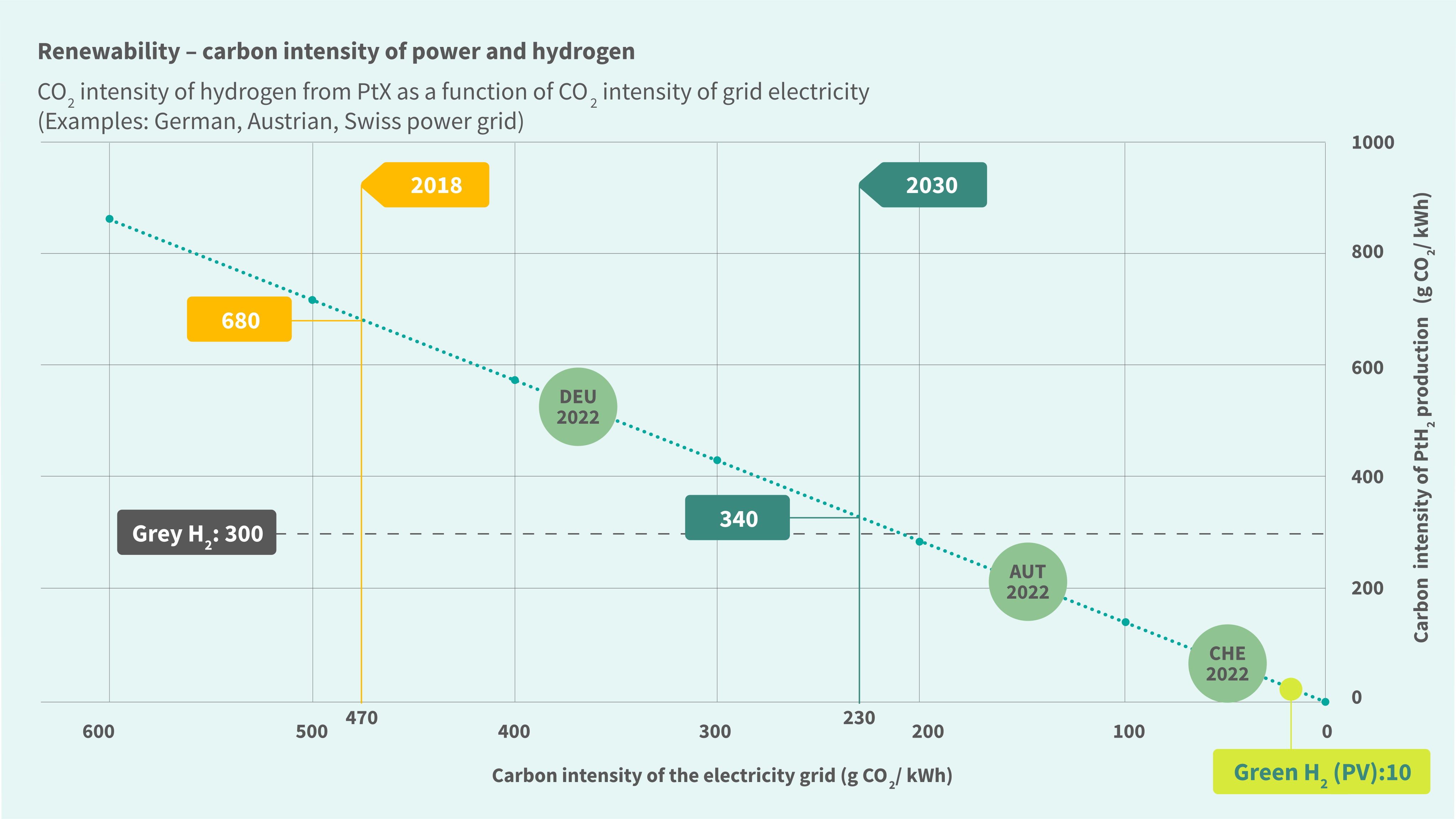
Renewability means that the electricity stems from wind, solar, hydro or geothermal energy, and not from fossil sources. The type of energy used to produce hydrogen and Power-to-X products has the strongest impact on its carbon footprint. Converting electricity into hydrogen and Power-to-X products inevitably leads to a loss of available energy. To produce 1 TWh of hydrogen, around 1.4 TWh of electricity is required – with significant variations, e.g. depending on the electrolyser full load hours. Accordingly, the greenhouse gas (GHG)-intensity embedded in hydrogen produced from water electrolysis will always be higher than that of the electricity used for its production, as seen in the figure and related explanatory note below.
Source: International PtX Hub (2021), own design, based on Öko-Institut (2019): Kasten, P. & Heinemann, C.: „Not to be taken for granted: climate protection and sustainability through PtX“, https://www.oeko.de/fileadmin/oekodoc/Impulspapier-soz-oek-Kriterien-e-fuels.pdf, p. 10.
Figure explanation: The contribution of Power-to-X (PtX) to climate mitigation depends crucially on two characteristics of the electricity used: renewability and additionality. This figure illustrates why it is important to use renewable electricity. On the vertical (y-)axis, it shows the carbon intensity of hydrogen from water electrolysis as a function of the carbon intensity of the type of electricity used, which is shown on the horizontal (x-)axis (from right to left). In both cases carbon intensity is measured in gCO2 equivalent per kWh. The dotted diagonal line indicates that due to conversion losses, the carbon intensity of hydrogen from water electrolysis is roughly 1.45 times higher than that of the electricity used to produce it. In 2018, the carbon intensity of the German power grid was 470 gCO2e/kWh. The carbon intensity of hydrogen, produced with this electricity was 680 gCO2e/kWh, which is more than twice as high as that of grey hydrogen produced with fossil gas (300 gCO2e/kWh). Even if – in accordance with an ambitious climate protection scenario – the German grid’s carbon intensity would come down to 230 gCO2e/kWh until 2030, the CO2 intensity of hydrogen from water electrolysis would still be at 340, thus, above the grey hydrogen reference level. The green circles show the carbon intensities of the German, Austrian and Swiss grids in 2022. Thanks to a high share of renewable (hydro) power, the Swiss grid has a low carbon intensity and would allow to produce low-carbon hydrogen from electrolysis. If hydrogen would be produced with electricity from a photovoltaic (PV) power facility only, its carbon intensity could be reduced to almost zero. This means: To contribute to climate protection, Power-to-X should rely on renewable electricity. Currently, in most countries and cases significant reductions in greenhouse gas intensity of hydrogen cannot be achieved with electricity from the power grid.
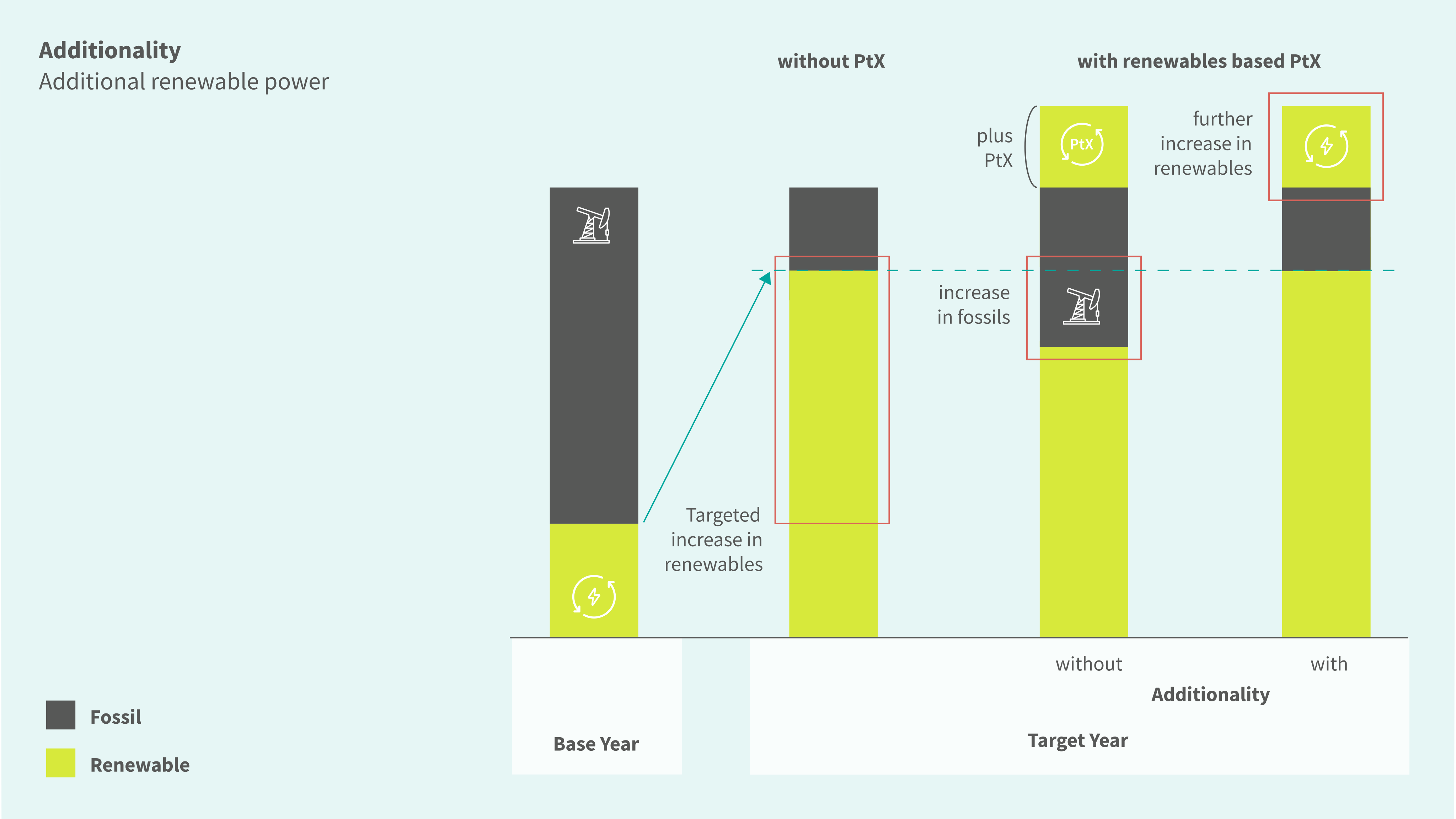
Additionality means that the energy used for Power-to-X production should stem from additional renewable electricity generation that is explicitly dedicated towards Power-to-X production. This is to ensure that Power-to-X production does not indirectly lead to an increase in fossil-based power use in other sectors, “through the back door”. To prevent this, regulation is needed ensuring that green hydrogen production does not divert renewable electricity away from the overall grid transformation. The figure below visualises why Power-to-X production should meet both conditions: renewability and additionality.
Source: International PtX Hub (2021), own design, based on Öko-Institut (2019): Kasten, P. & Heinemann, C.: „Not to be taken for granted: climate protection and sustainability through PtX“, https://www.oeko.de/fileadmin/oekodoc/Impulse_paper_criteria_for_e-fuel_production.pdf, p. 10.
Figure explanation: To be truly sustainable, electricity used for hydrogen and Power-to-X production must not only be renewable. It must also be additional. This graph explains why additionality matters. For the base year it shows the national power mix from fossil and renewable sources. For a given target year the share of renewables shall be significantly increased. If by that time Power-to-X shall be produced with renewable electricity there is a risk that this power will simply be diverted from other uses. If these other uses were then forced to switch to electricity from coal, oil or gas, PtX would effectively bring in fossil electricity “through the back door”. Thus, the Power-to-X power demand should be covered by additional renewable electricity in order not to undermine the already planned energy transition of the grid. Power-to-X production should not lead to an increase in fossil energy use. Power-to-X roadmaps must therefore be fully integrated into national energy and climate strategies such as the Nationally Determined Contributions (NDCs) under the Paris Climate Agreement.
In order to ensure that hydrogen and Power-to-X production is also not destabilising electricity grids, the EU has established further conditions of geographic and temporal correlation. These requirements apply to both domestically produced and imported products if they are to be sold as ‘renewable hydrogen’ or ‘Renewable Fuels of Non-Biological Origin’ (RFNBOs).
Carbon Cycle
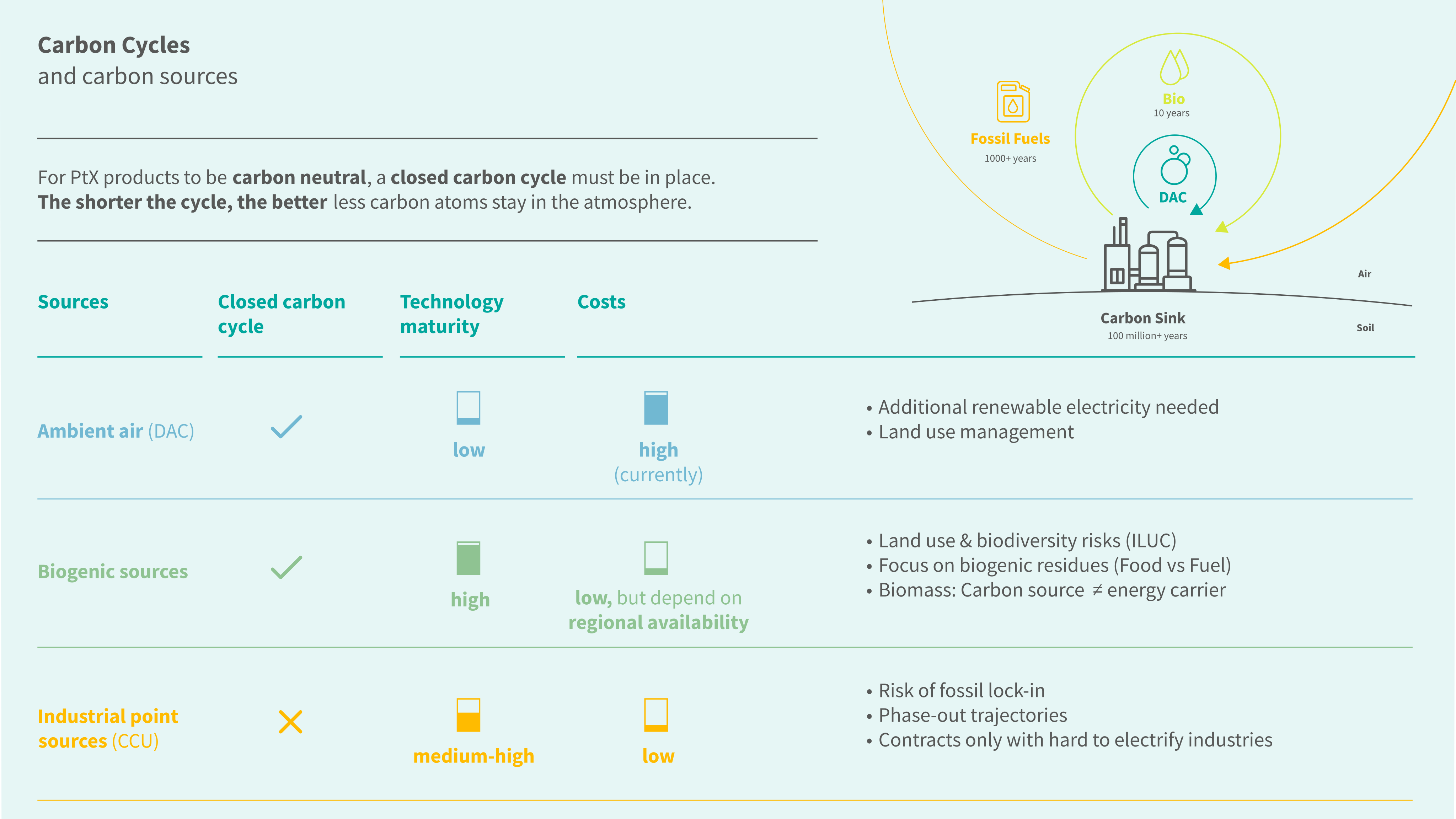
A carbon cycle describes the process by which carbon atoms are exchanged from the atmosphere to the earth and then back into the atmosphere. To produce a variety of Power-to-X products, such as methane, methanol, synthetic e- kerosene, carbon is a necessary input. Therefore, to produce sustainable Power-to-X products, this carbon must not add to the atmospheric accumulation of GHG. In a sustainable carbon cycle for Power-to-X products, carbon inputs are sequestered from the atmosphere, stocked in synthetic hydrocarbons like fuels, and then emitted back into the atmosphere when these synthetic hydrocarbons are combusted. This Power-to-X carbon cycle is closed and thus does not add to GHG accumulation in the atmosphere.
In general, three different types of carbon sources can be distinguished:
- Direct Air Capture (DAC) installations directly remove CO₂ from the ambient atmosphere;
- Biogenic sources, ideally from waste and biogenic residues; and
- Carbon Capture and Use (CCU) from hard-to-abate industrial point sources such as cement or steel plants.
Source: International PtX Hub, own illustration.
Figure explanation: For Power-to-X products that require a synthesis of green hydrogen and carbon, three different carbon sources can be distinguished: Direct Air Capture (DAC), biogenic sources, and industrial point sources. This figure summarises their respective characteristics, advantages and disadvantages: only DAC and biogenic residues can be considered carbon neutral and part of a closed carbon cycle. DAC captures carbon directly from the atmosphere, while the carbon contained in biogenic residues was originally absorbed from the atmosphere by plants through photosynthesis. In contrast, carbon captured from industrial point sources does not usually originate from a closed carbon cycle. In many cases, this carbon is fossil carbon derived from natural gas, oil, or coal. Unlike biogenic carbon, fossil carbon was not recently removed from the atmosphere. Instead, it is extracted from geological reservoirs and released into the atmosphere, thereby introducing additional carbon into the atmosphere. It should only be considered as a temporary option in early ramp-up phases of Power-to-X, coupled with clear defossilisation strategies. Whilst the scalability of DAC is high, technological maturity is still low and costs are high. Although capture and use of biogenic and industrial carbon is largely technologically mature, and the costs are comparatively low, scalability is limited, depending on local conditions. The most critical sustainability issues are: DAC: the need for additional electricity from renewable energy sources to power the DAC facilities; biogenic sources: direct and indirect land use changes and risks to biodiversity, as well as potential trade-offs with food security; industrial Carbon Capture and Usage (CCU): lock-in of fossil technologies and supply chains. For Power-to-X products to be carbon neutral, a closed carbon cycle must be in place.The shorter the cycle, the better, since less carbon atoms stay in the atmosphere.
DAC is regarded the best long-term solution. It ensures a closed carbon cycle. The availability of carbon from ambient air is evenly distributed across different regions and is not expected to decrease significantly in the long-term.
However, DAC is an energy-intensive process and also occupies significant amounts of land. Therefore, DAC should meet the same requirements as those for electricity: renewability and additionality. Currently, DAC technologies are still expensive and have not yet reached the level of technology readiness required for them to dominate Power-to-X production in the short term.
Biogenic carbon sources are biogas, bioethanol, solid biomass or fermented materials and waste streams. All these have captured carbon from the environment. However, the availability of biogenic sources is limited and unevenly distributed. For example, waste streams mostly occur in large cities, which might be far from available land for solar and wind parks. Moreover, biogenic carbon sources have a limited scalability and will not be able to satisfy future demand on their own.
They could however help to kickstart the Power-to-X market as it offers a sufficient level of technology readiness. It is important that the used biomass respects all the established sustainability criteria for biomass products, in particular with regard to land use and land use change. For example, cultivating biomass as carbon input for Power-to-X production should not compete with agricultural production for food and feed.
Industrial point sources using CCU technologies cannot be considered renewable since the carbon usually comes from fossil sources, meaning the carbon cycle is not closed, but brings more fossil carbon into the atmosphere. Reliance on CCU is risky since it may lead to a lock-in into fossil technologies that should be phased out. It might also create price incentives in favour of fossil-based processes. Still, CCU technologies are more energy efficient and have a higher level of technology readiness than DAC. It might therefore be a valuable option to use them for upscaling Power-to-X production but its application should be limited in time and to hard-to-electrify sectors.


